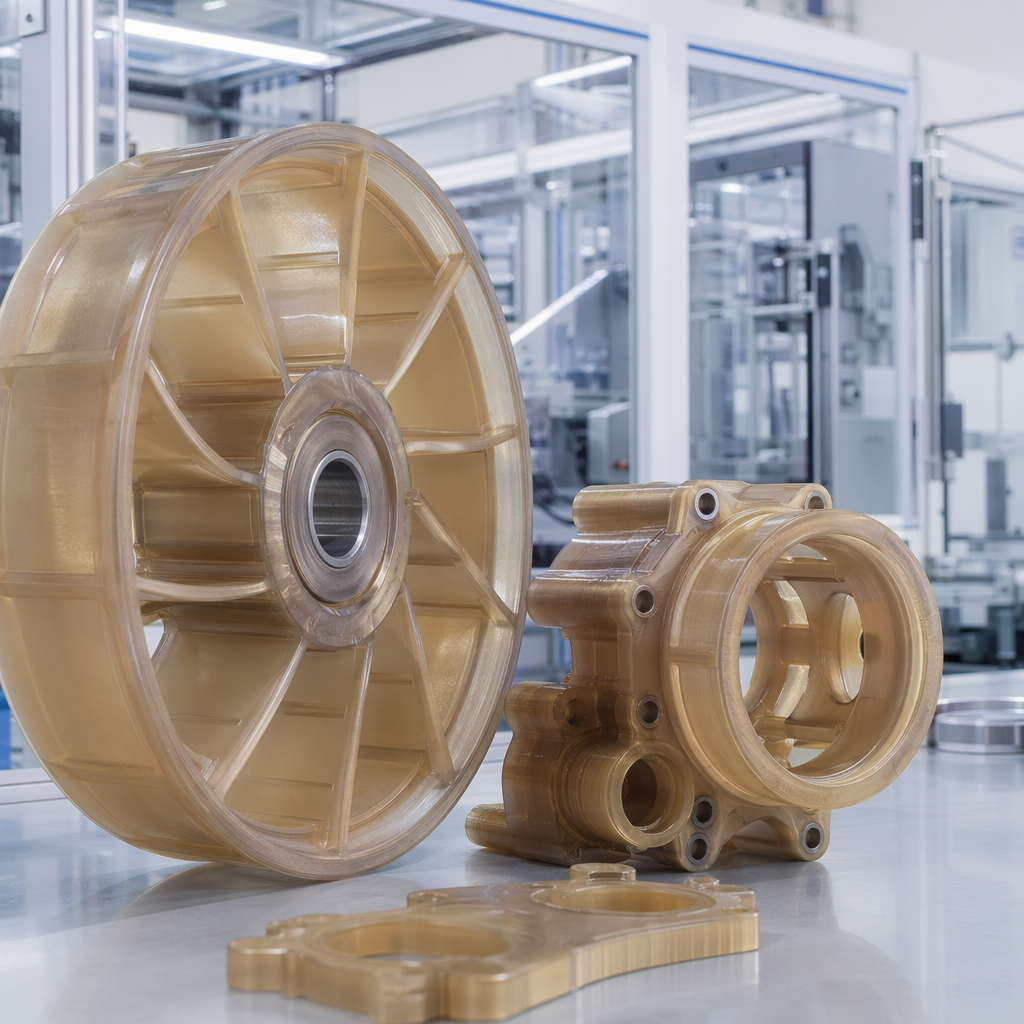
PEI, often recognized by the Ultem trade name, is selected when a plastic part must retain useful performance at elevated temperature while also providing strong dielectric, flame and dimensional characteristics. Grade choice and process route matter: an unfilled PEI molding grade, a glass-reinforced grade, Ultem 9085 additive material and a machined stock shape are not interchangeable options. This guide helps buyers define the right PEI route for a real part.
What makes PEI different
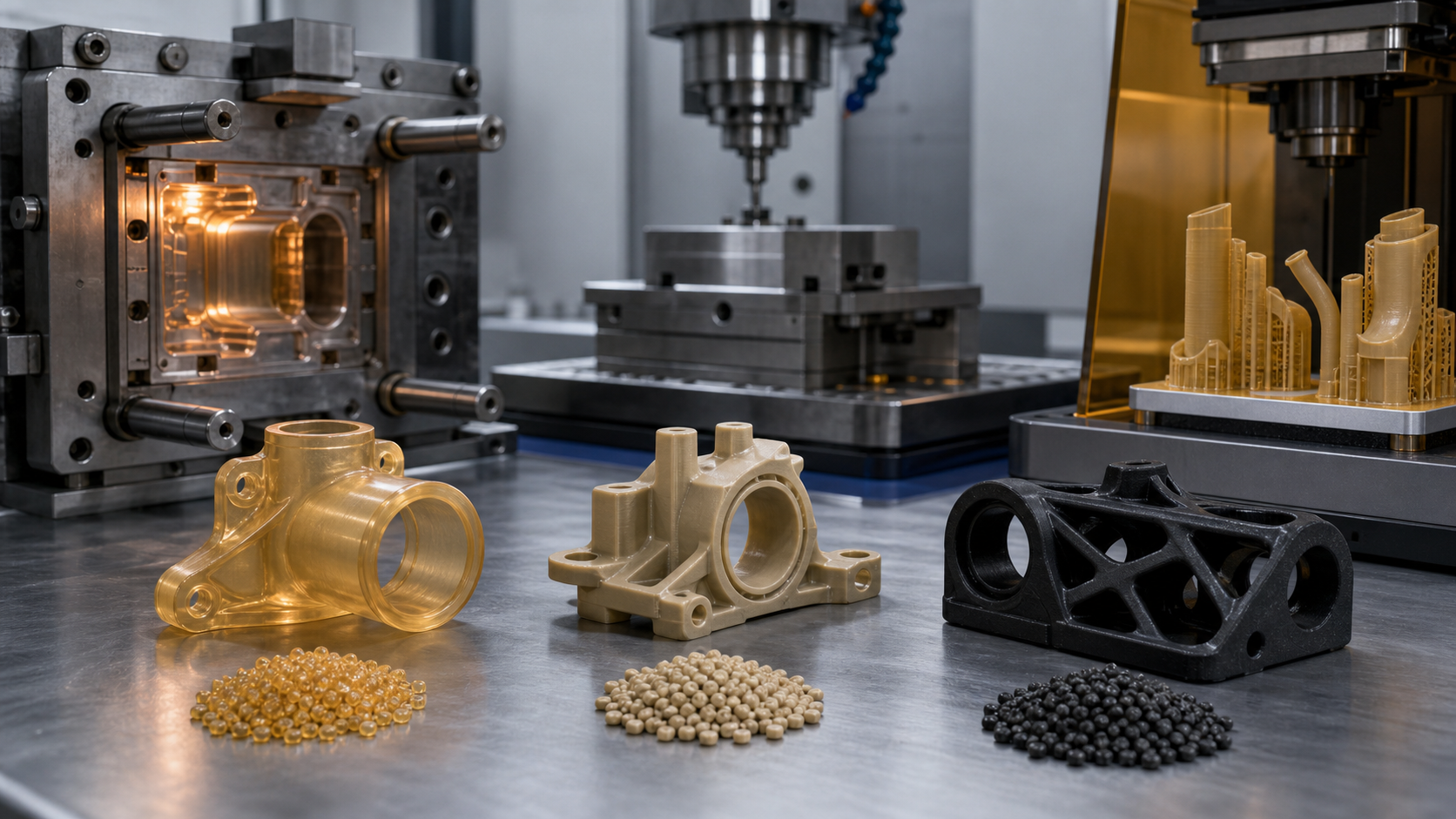
PEI is an amorphous high-performance thermoplastic with a high glass-transition temperature, useful dimensional stability and resistance to many industrial fluids. It is often considered for electrical insulation, connectors, sensor housings, aerospace interiors, medical equipment components and fixtures that must remain stable near heat. The exact grade still controls flame behavior, reinforcement, color, strength, dielectric performance and processing conditions.
| PEI option | El más adecuado | Points to confirm |
|---|---|---|
| Unfilled PEI, such as Ultem 1000 family | Complex molded parts needing balanced thermal, electrical and dimensional performance | Color, flame rating, chemical exposure and molding window |
| Glass-reinforced PEI | Higher stiffness, creep resistance and dimensional support | Fiber orientation, anisotropic shrinkage and surface appearance |
| Ultem 9085 or similar additive grade | Low-volume complex parts, prototypes and some qualified production applications | Machine qualification, build direction, porosity and post-processing |
| PEI stock for CNC machining | Prototype and low-volume precision parts from plate, rod or block | Stock condition, residual stress, tool wear and inspection access |
Choose the process route
Injection molding is usually efficient for repeat production once geometry and annual volume justify tooling. It offers repeatable cycle control and good unit economics, but the tool must account for draft, gates, weld lines, venting, ejection and local thickness. Glass-filled PEI may require special attention to tool wear and flow orientation.
CNC machining is useful when quantity is low, the design is still changing or the part requires tight local features from stable stock. It avoids an injection mold, but material utilization, machining time, burr control and internal stress can dominate cost. Thin walls and deep pockets need a manufacturing review before tolerances are promised.
Additive manufacturing can shorten the path to a complex first article and may reduce material waste. It requires careful control of build orientation, support removal, thermal history, surface finish and dimensional compensation. For regulated applications, confirm that the exact machine, material, operator and post-processing route are approved for the intended use.
Processing and design considerations
PEI must be dried according to the grade supplier’s instructions because residual moisture can cause splay, bubbles, hydrolysis or reduced performance during molding. Molding temperature, mold temperature, residence time and venting need to stay within the grade window. Excessive residence time can damage the polymer even when the part looks acceptable.
Design for uniform walls, sensible radii and adequate draft. Avoid forcing a high-temperature polymer through unnecessarily thin sections. Reinforced PEI can reduce shrinkage in the fiber direction but increase directional variation. Machined parts should be rough-machined, allowed to relax when appropriate, then finish-machined and inspected if tolerance is sensitive to stress release. Pay attention to holes, threads, thin webs and sealing faces. Define the free-state condition, datum scheme and allowable cosmetic marks before production so the acceptance standard is unambiguous.
| Requisito | Buyer-side verification | Common risk |
|---|---|---|
| Heat exposure | Review continuous and peak temperatures with load applied | Datasheet value used without mechanical or time context |
| Electrical insulation | Specify dielectric test, frequency, conditioning and thickness | Grade or moisture condition differs from the application |
| Comportamiento frente al fuego | Confirm exact grade, thickness and recognized test basis | Rating assumed across colors, processes or geometries |
| Estabilidad dimensional | Measure datums, holes and mating features after conditioning | Fiber orientation, residual stress or thermal cycling changes fit |
Documentation and inspection
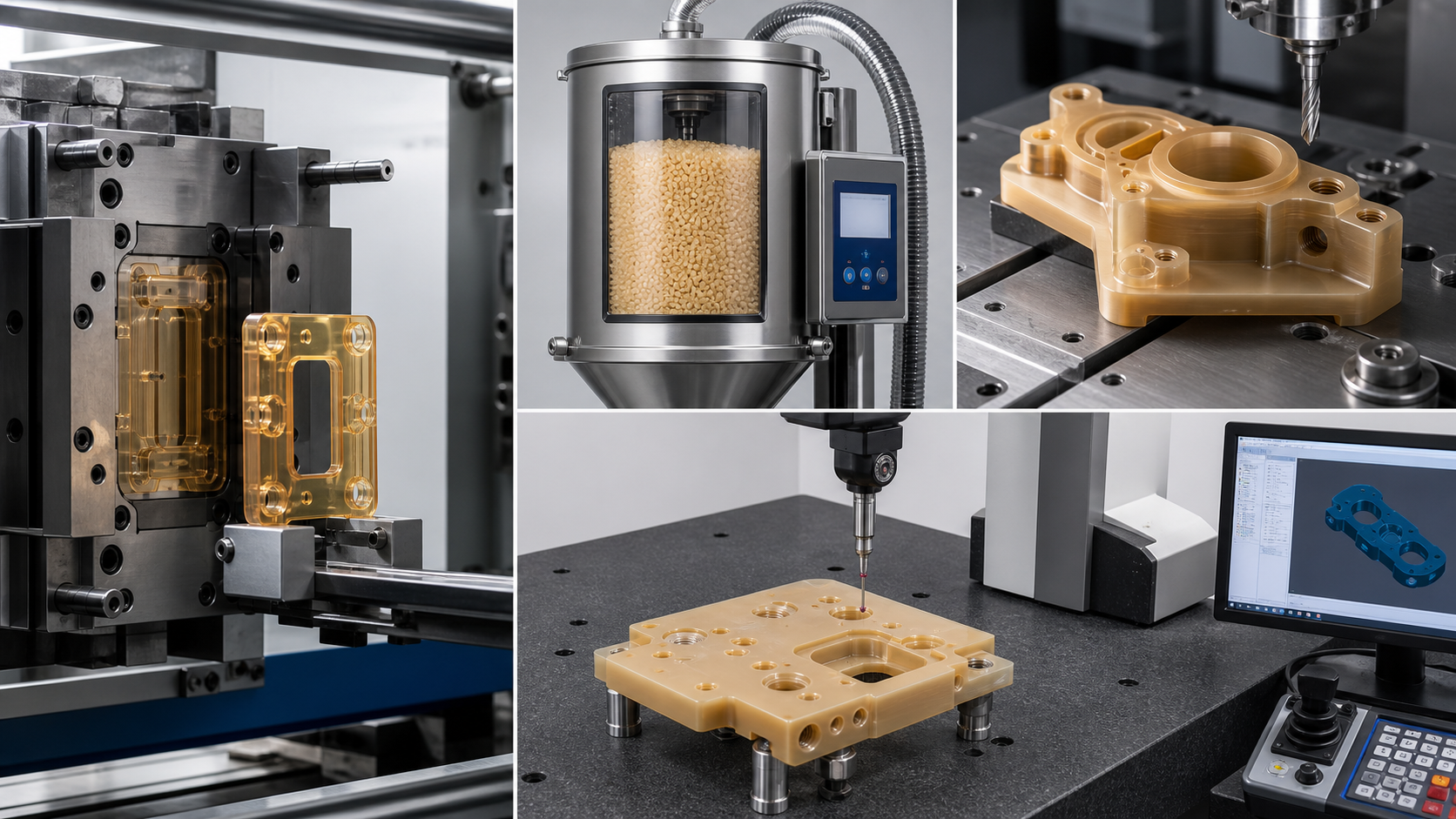
For an RFQ, provide the grade preference, drawing revision, 3D model, service temperature, load, chemicals, electrical requirements, color, finish, quantity and required records. Ask whether the quote is based on molding, CNC machining or additive production, and request the proposed inspection method for critical features. Certificates, lot traceability and special-process records should be agreed before the purchase order when the application requires them.
We can review PEI grade selection, process route, drying and handling requirements, tolerance risk and inspection points before a pilot run. A short design review often identifies whether the real risk is the resin, the process, the geometry or the acceptance plan. This is especially useful when a prototype route will later change to molded production.
PEI Ultem selection should distinguish molding grades, reinforced stock, Ultem 9085 additive material and machined shapes before an RFQ is approved.
For process-route comparison, see our CNC machining services y 3D printing guide.
Preguntas frecuentes
Is PEI the same as Ultem?
PEI is the polymer family. Ultem is a widely used trade name associated with specific PEI grades. Always identify the exact grade and supplier rather than using the names as if they were interchangeable.
Which is better for PEI, molding or CNC machining?
Molding usually suits repeat production with a stable design, while CNC machining suits prototypes and low volumes from stock. Geometry, tolerance, quantity and documentation requirements should drive the decision.
Does PEI need drying before molding?
Yes, PEI should be dried and handled within the grade supplier’s moisture limits. The exact time and temperature depend on grade, pellet condition and dryer performance.
Can glass-filled PEI hold tighter tolerances?
It can improve stiffness and reduce some shrinkage, but fiber orientation may create anisotropy and warpage. Tolerances should be validated on the actual geometry and process route.
What information should I send for a PEI quote?
Send the model, drawing, grade or performance target, quantity, service environment, critical tolerances, finish, color, inspection records and any required compliance or traceability documentation.