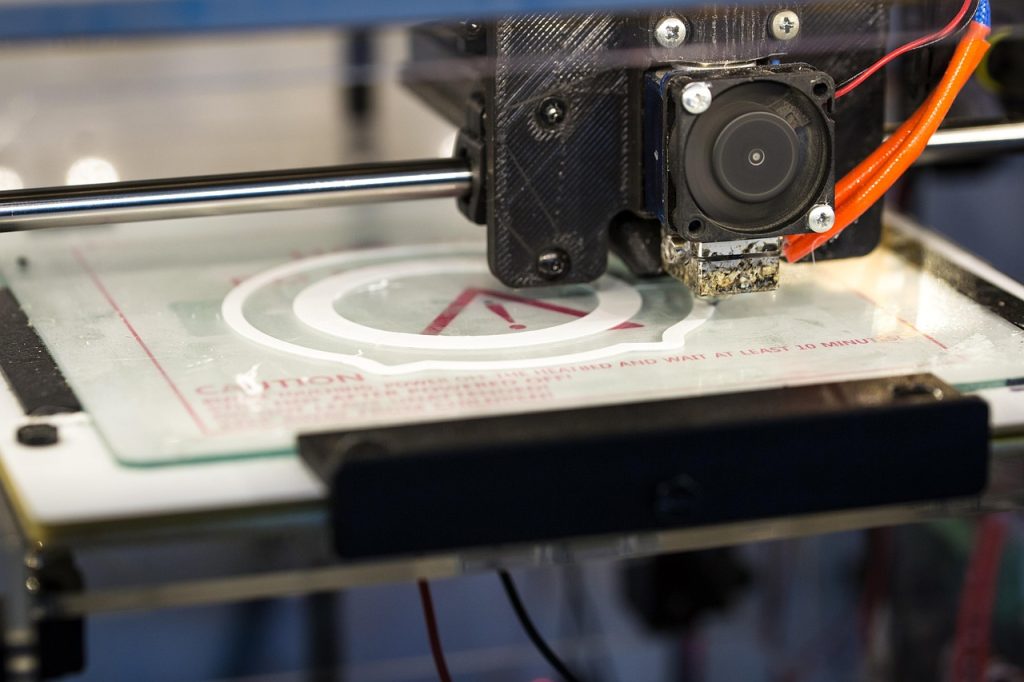
La impresión 3D con filamento ABS da buenos resultados cuando la estabilidad de la cámara, la preparación de la cama y el control térmico funcionan en conjunto. El acrilonitrilo-butadieno-estireno (ABS) fue el primer filamento de ingeniería. Antes de que el PLA dominara el mercado para principiantes, antes de que el PETG ofreciera un término medio y mucho antes de que aparecieran en escena los exóticos nailon con relleno, el ABS era el material que se utilizaba si se querían piezas que realmente funcionaran. Sigue siendo uno de los materiales FDM más versátiles y utilizados para prototipos funcionales, piezas de uso final y aplicaciones en las que la resistencia al calor y a los impactos es imprescindible. Si todavía estás dudando entre los materiales más comunes, nuestro Comparación entre PLA, PETG y ABS es un buen filtro para empezar.
El ABS tiene fama de ser difícil de imprimir: la deformación, el olor, los requisitos de la cámara de impresión. En parte, esa reputación está justificada. Pero otra parte está desfasada, es un vestigio de la época anterior a que las plataformas calefactadas y las cámaras cerradas se convirtieran en equipamiento estándar. Esta guía separa los hechos de las leyendas y ofrece un flujo de trabajo de impresión completo que permite producir piezas de ABS resistentes y con precisión dimensional con las mínimas complicaciones. Si el levantamiento de las esquinas es tu principal problema, nuestro Guía sobre la deformación en la impresión 3D profundiza en los aspectos relacionados con el encapsulado, la adhesión y el control del gradiente térmico.
Qué es realmente el ABS: el sistema de tres monómeros
El ABS es un terpolímero —un copolímero formado por tres monómeros distintos— y cada uno de ellos aporta una propiedad diferente al material final. El acrilonitrilo proporciona resistencia química, estabilidad térmica y dureza superficial. El butadieno aporta resistencia al impacto y tenacidad, especialmente a bajas temperaturas. El estireno aporta rigidez, brillo y facilidad de procesamiento. La proporción de estos tres componentes determina el equilibrio de las propiedades: un mayor contenido de acrilonitrilo mejora la resistencia química y térmica; un mayor contenido de butadieno mejora la resistencia al impacto; y un mayor contenido de estireno mejora la rigidez y el acabado superficial.
La mayoría de los filamentos de ABS para impresión 3D utilizan una proporción de acrilonitrilo-butadieno-estireno que oscila entre el 15 y el 35% de acrilonitrilo, el 5 y el 30% de butadieno, y el 40 y el 60% de estireno. El componente de butadieno se presenta en forma de partículas de caucho discretas dispersas en una matriz continua de SAN (estireno-acrilonitrilo); esta morfología bifásica es la que confiere al ABS su característica combinación de rigidez y tenacidad. La matriz de SAN aporta resistencia y rigidez; las partículas de caucho de butadieno absorben la energía de impacto mediante cavitación e induciendo un flujo por cizallamiento en la matriz circundante.
Esta estructura también explica la relación del ABS con la acetona. La acetona disuelve la fase matricial de SAN —el copolímero de estireno y acrilonitrilo—, mientras que los dominios de caucho de butadieno permanecen como fase dispersa. Esta disolución selectiva es la base del alisado con vapor de acetona, que funde el SAN superficial para crear un acabado brillante y sellado, mientras que los dominios de caucho mantienen la integridad mecánica subyacente.
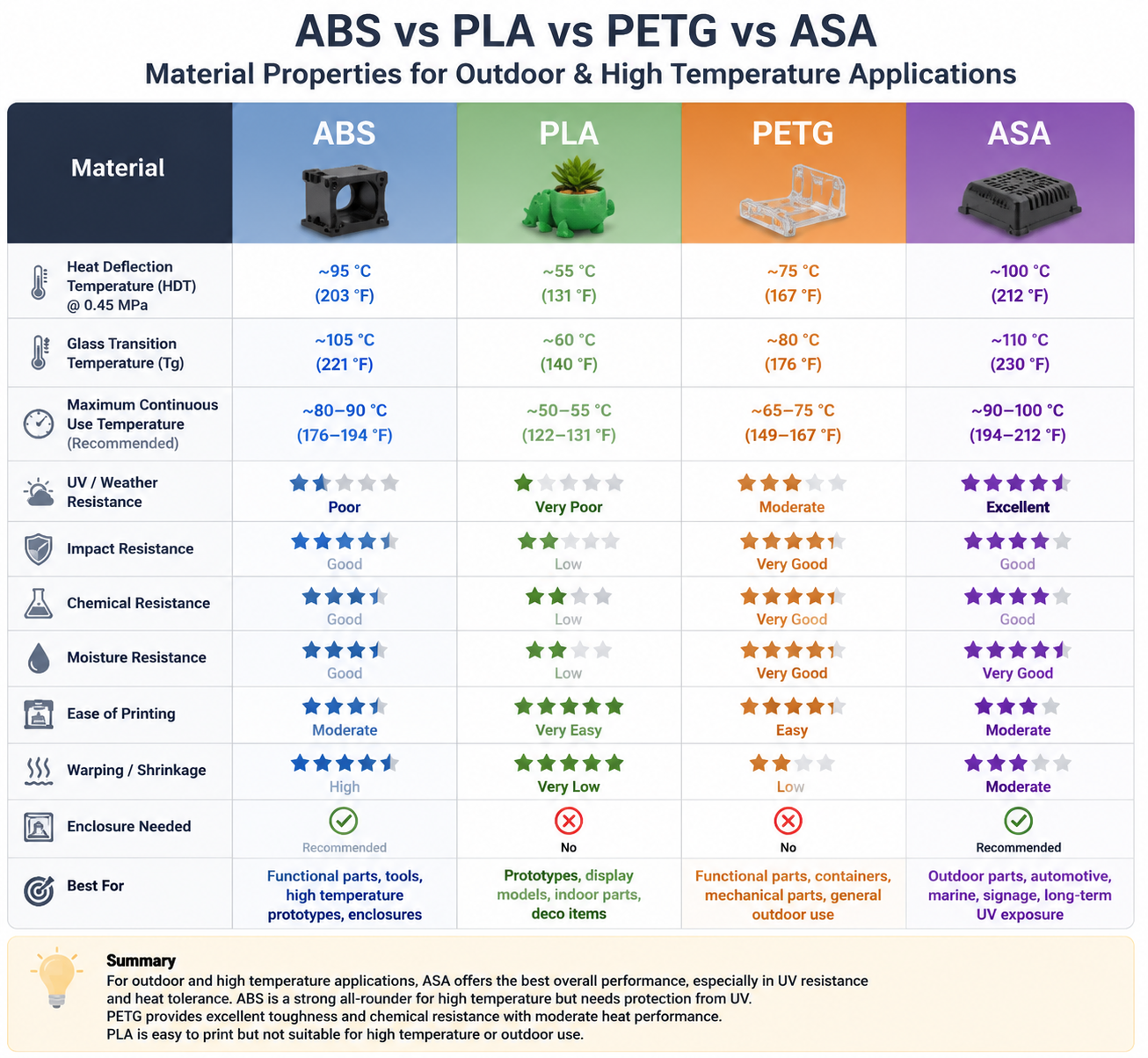
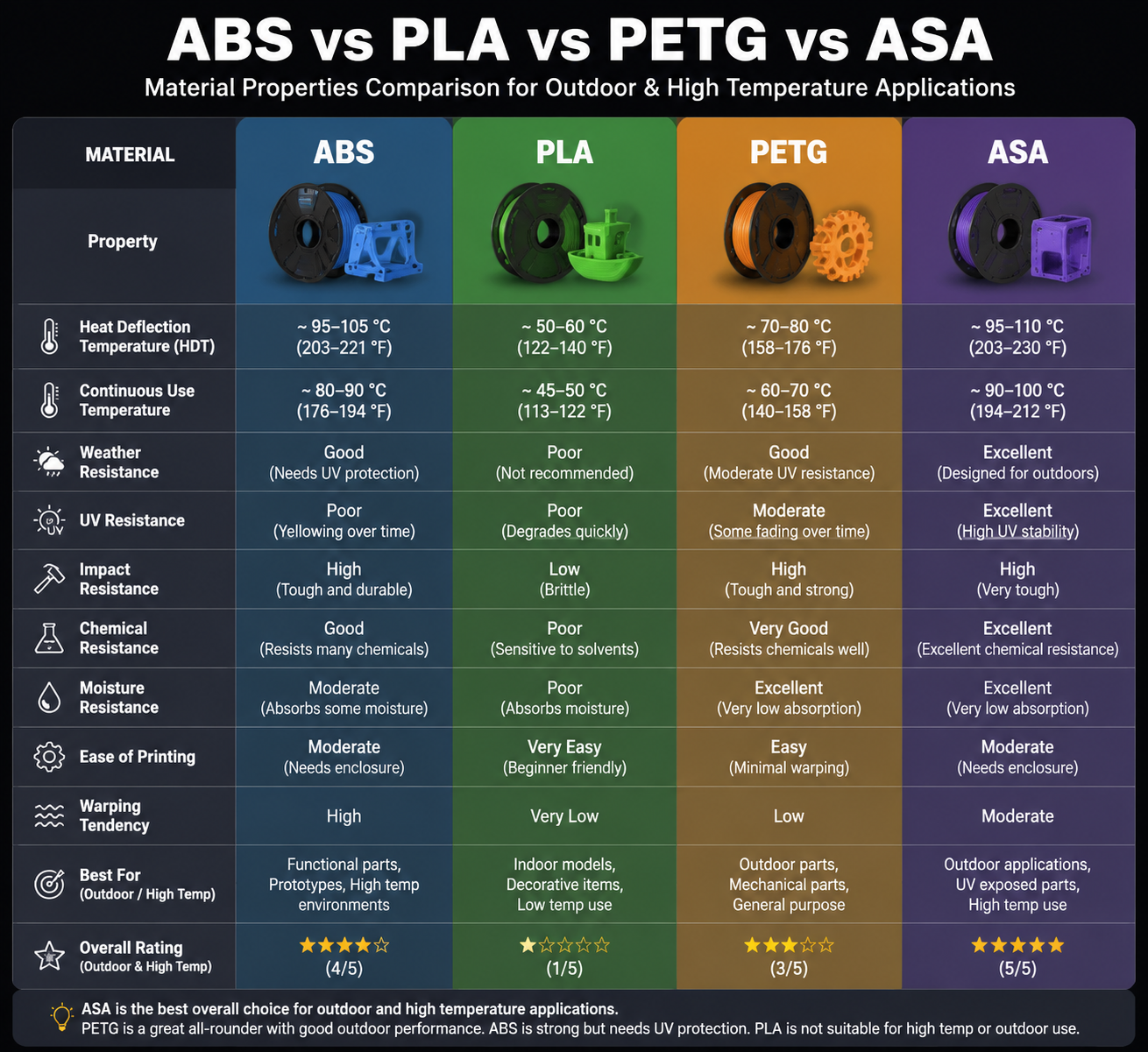
| Propiedad | ABS | PLA | PETG | ASA |
|---|---|---|---|---|
| Resistencia a la tracción | 35-45 MPa | 50-60 | 50-55 | 35-45 |
| Resistencia al impacto (Izod) | 200-400 J/m | 30-50 | 80-110 | 150-350 |
| Transición vítrea (Tg) | ~105 °C | ~60 °C | ~80°C | ~105 °C |
| HDT (0,45 MPa) | ~95 °C | ~55 °C | ~70 °C | ~95 °C |
| Alargamiento a la rotura | 10-25% | 5-10% | 15-25% | 15-30% |
| Resistencia a los rayos UV | Pobre | Feria | Bien | Excelente |
| Densidad | 1,04 g/cm³ | 1.24 | 1.27 | 1.07 |
| Precio por kg | $20-35 | $20-30 | $25-40 | $30-45 |
Requisitos de la impresora: lo que exige el ABS
El ABS es menos tolerante con el hardware de calidad media que el PLA o el PETG, pero los requisitos se conocen bien y la mayoría de las impresoras modernas los cumplen. Los tres elementos esenciales son un hotend totalmente metálico capaz de alcanzar entre 230 y 260 °C, una cama calefactada que pueda mantener entre 90 y 110 °C, y una cabina que mantenga una temperatura ambiente de entre 40 y 60 °C. Cada elemento aborda un modo específico de fallo en la impresión con ABS.
La necesidad de un hotend totalmente metálico se debe a que las temperaturas de impresión del ABS oscilan entre los 230 y los 260 °C. Los hotends revestidos de PTFE comienzan a degradarse por encima de los 240 °C aproximadamente, lo que provoca la emisión de humos y la pérdida progresiva de sus propiedades antiadherentes. La mayoría de los ABS se imprimen a 240-250 °C, lo que se sitúa justo en el umbral de degradación de los hotends revestidos de PTFE. Un hotend totalmente metálico elimina este problema y permite aprovechar todo el rango de temperaturas del que se beneficia el ABS.
La cama calefactada a 90-110 °C es imprescindible. El ABS tiene una temperatura de transición vítrea de aproximadamente 105 °C, y la cama debe estar a esta temperatura o cerca de ella para mantener las primeras capas por encima de la Tg. Esto evita el enfriamiento diferencial que provoca la deformación: cuando las capas inferiores se enfrían por debajo de la Tg mientras las capas superiores aún se están depositando, la diferencia de contracción entre la parte inferior solidificada y la parte superior que aún se contrae crea un momento flector que levanta las esquinas y los bordes de la placa de impresión.
La cámara de impresión es el factor en el que las granjas de impresión y los principiantes difieren de forma más notable. Una cámara con calefacción pasiva —una caja que rodea la impresora y que retiene el calor residual de la plataforma y del hotend— suele alcanzar entre 35 y 45 °C, lo cual es adecuado para piezas de ABS de tamaño pequeño a mediano. Las cámaras con calefacción activa, a una temperatura de entre 55 y 65 °C, producen piezas fiables, planas y sin tensiones, incluso en el caso de geometrías de gran tamaño. Lo que importa es la reducción de la temperatura ambiente a través de la pared de la cámara: si la temperatura ambiente exterior a la cámara es de 20 °C y la interior de 45 °C, el gradiente de 25 °C a través de la pared de la cámara es manejable. Sin una cámara, la superficie de la pieza se ve sometida directamente a un gradiente de 40-50 °C, y la deformación es casi segura para cualquier pieza de más de aproximadamente 50 mm en cualquiera de sus dimensiones.
Adherencia a la cama en el ABS: la guía completa sobre superficies
La adhesión a la base en el caso del ABS es un problema ya resuelto, pero la solución depende de la superficie de la base. No hay una respuesta universal: la elección correcta depende de sobre qué estés imprimiendo.
Láminas de PEI (polieterimida)
El PEI es el estándar de referencia para la adhesión del ABS a la cama de impresión. A una temperatura de la cama de entre 100 y 110 °C, el ABS forma una unión sólida con superficies de PEI limpias. La clave del PEI está en la preparación de la superficie: límpiala con alcohol isopropílico entre impresión e impresión y, periódicamente —cada 20-30 impresiones o cuando la adherencia empiece a disminuir—, frótala con lana de acero 0000 y acetona para eliminar la capa superficial oxidada y dejar al descubierto el PEI nuevo. No utilices acetona sobre el PEI más de una vez cada 20-30 impresiones; el PEI es resistente a la acetona, pero no a prueba de acetona, y una limpieza excesiva degrada la superficie.
Importante: no imprimas ABS directamente sobre PEI liso a temperaturas superiores a 110 °C. A estas temperaturas, la adhesión entre el ABS y el PEI puede llegar a ser tan fuerte que el recubrimiento de PEI se desprenda de la chapa de acero al retirar las piezas. El PEI texturizado evita este problema al limitar la superficie de contacto y proporcionar puntos de concentración de tensiones que facilitan la extracción de las piezas.
Cinta Kapton (película de poliimida)
La cinta Kapton sobre cristal fue la superficie de cama de ABS original, y sigue funcionando. La película de poliimida ofrece una excelente adhesión a 100-110 °C, y las piezas se desprenden limpiamente cuando la cama se enfría por debajo de aproximadamente 60 °C. La principal desventaja es su aplicación —colocar la cinta Kapton sin burbujas ni arrugas requiere práctica— y su durabilidad, ya que la cinta debe sustituirse tras entre 5 y 15 impresiones, dependiendo del tamaño de la pieza y de la técnica de desmoldeo.
Suspensión de ABS (ABS disuelto en acetona)
La solución económica clásica: disuelve unos pocos gramos de filamento de ABS o restos de este en 50-100 ml de acetona para crear una pasta líquida y, a continuación, aplícala con un pincel sobre la superficie de impresión. La acetona se evapora, dejando una fina película de ABS a la que la pieza impresa se adhiere químicamente. Es eficaz y prácticamente gratuito, pero ensucia, y los vapores de acetona requieren ventilación. Este método funciona de forma fiable sobre cristal, aluminio y casi cualquier superficie de impresión rígida.
Barra de pegamento y laca para el pelo
Una barra de pegamento a base de PVA (la variedad morada de Elmer’s es la más habitual en la comunidad) aplicada sobre una cama calefactada a 100 °C proporciona una capa de separación a la que el ABS se adhiere adecuadamente y de la que se desprende limpiamente. El mecanismo es diferente al del PEI o el Kapton: la barra de pegamento actúa como una interfaz sacrificial que se adhiere tanto a la placa de impresión como a la pieza de ABS, separándose limpiamente de ambas. La laca para el pelo funciona de manera similar: la película de copolímero (normalmente un copolímero de acetato de vinilo y ácido crotónico) se adhiere al cristal y proporciona una superficie a la que puede adherirse el ABS caliente.
Ajustes de impresión: temperatura, velocidad y la paradoja del enfriamiento
Temperatura de la boquilla: 230-260 °C
La mayoría de los ABS se imprimen bien a 240-250 °C. Por debajo de 230 °C, la adhesión entre capas se ve afectada porque el cordón extruido no puede volver a fundir adecuadamente la superficie de la capa anterior. Por encima de 260 °C, comienza la degradación térmica de la fase de butadieno, lo que provoca decoloración y una menor resistencia al impacto. Imprime una torre de temperatura de 230 a 260 °C en incrementos de 5 °C y, a continuación, rompe la torre: la temperatura que produzca la mayor resistencia entre capas sin decoloración es el ajuste óptimo para esa bobina concreta de filamento.
Temperatura de la cama: 100-110 °C
Ajusta la temperatura de la plataforma a 100-110 °C para la primera capa y mantén esta temperatura durante toda la impresión. Reducir la temperatura de la plataforma tras las primeras capas —una estrategia habitual con el PLA— resulta contraproducente para el ABS, ya que la pieza necesita un control del gradiente térmico durante todo el tiempo que dura la impresión.
Refrigeración: el ajuste más malinterpretado
La creencia generalizada de que el ABS no requiere refrigeración alguna de la pieza es errónea; o, mejor dicho, solo es cierta en el caso de las impresoras al aire libre, en las que cualquier ventilador de refrigeración genera un gradiente térmico perjudicial. En una impresora cerrada con una temperatura ambiente de entre 40 y 60 °C, una refrigeración moderada de la pieza con una velocidad del ventilador de entre 20 y 40% mejora el rendimiento en los salientes, reduce la formación de hilos y produce esquinas más definidas sin provocar deformaciones. La variable clave es la temperatura del aire: si el aire del interior de la cabina está a 45 °C, soplar aire a 45 °C sobre la pieza no provoca un choque térmico. Sin embargo, soplar aire ambiente a 20 °C —que es lo que ocurre en una impresora abierta— provocará sin duda alguna deformaciones y delaminación.
Recomendación práctica: con una carcasa adecuada que mantenga una temperatura mínima de 40 °C, utiliza el ventilador de refrigeración de piezas 20-30% tras las capas 3-5. Desactiva el ventilador en puentes y salientes con una inclinación superior a 45° para evitar un enfriamiento localizado excesivo. En el caso de las impresoras sin carcasas, mantenga el ventilador completamente apagado y acepte la merma en la calidad de los voladizos.
Velocidad de impresión: 40-60 mm/s
El ABS se beneficia de velocidades de impresión moderadas. Entre 40 y 60 mm/s para los perímetros y entre 60 y 80 mm/s para el relleno se obtienen resultados uniformes. Una velocidad superior a 80 mm/s suele provocar una mala adhesión entre capas, independientemente de la temperatura, ya que el cordón extruido no tiene tiempo suficiente para adherirse a la capa anterior. Una velocidad inferior a 30 mm/s conlleva el riesgo de sobrecalentar la pieza: al quedar el calor atrapado en la cámara y al permanecer el hotend sobre la misma zona durante demasiado tiempo, puede producirse una degradación térmica localizada.
Retracción: Cómo combatir al «demonio de las hebras»
El ABS produce más hilos que el PLA y menos que el PETG, pero sigue produciendo hilos. Una retracción de 4-7 mm a una velocidad de 25-40 mm/s para extrusoras Bowden, o de 1-2 mm a una velocidad de 25-35 mm/s para extrusoras de accionamiento directo, suele controlar eficazmente la formación de hilos. Si el efecto de hilos persiste con estos ajustes, es probable que el filamento contenga humedad: el ABS es moderadamente higroscópico y absorbe entre un 0,2 y un 0,41 TP3T de humedad en peso, lo cual es suficiente para provocar un efecto de hilos visible y una degradación de la calidad de la superficie. Si el efecto de hilo resulta problemático, seca el ABS a 70-80 °C durante 4-6 horas antes de imprimir.
Posprocesado: Suavizado con vapor de acetona y otras técnicas
El alisado con vapor de acetona es la técnica de posprocesamiento característica del ABS y constituye uno de los principales argumentos a favor de este material para aplicaciones en las que el acabado superficial es importante. El proceso es sencillo en teoría: se suspende la pieza impresa sobre un charco de acetona líquida en un recipiente hermético, se deja que el vapor de acetona se condense sobre la superficie de la pieza y la disuelva, y, a continuación, se retira la pieza y se deja secar. El resultado es un aspecto brillante, similar al del moldeo por inyección, con las líneas de capa rellenadas y una superficie sellada.
La ejecución requiere prestar atención a los detalles. La acetona es altamente inflamable (punto de inflamación: -20 °C) y su vapor es más denso que el aire, lo que significa que se acumula en los puntos bajos. El alisado con vapor debe realizarse en una zona bien ventilada o, idealmente, en una máquina específica para ello que cuente con control de temperatura y recuperación del disolvente. Los parámetros del proceso —tiempo de exposición, temperatura y volumen de acetona— determinan el resultado: entre 15 y 30 minutos a 40-50 °C producen una superficie brillante; una exposición más prolongada o una temperatura más alta disuelven demasiado material y redondean los bordes afilados y los detalles pequeños. El alisado con vapor frío a temperatura ambiente tarda entre 1 y 4 horas, pero permite un control más preciso y conserva mejor la precisión dimensional.
Entre las alternativas al alisado con acetona se incluyen el lijado (el ABS se lija bien: empieza con un grano 220 y ve subiendo hasta un grano de 800 a 1200 para obtener un acabado mate), el relleno y la aplicación de imprimación (la masilla para carrocerías, la imprimación de relleno y el lijado producen una superficie lista para pintar), y el recubrimiento epoxi (el XTC-3D o un epoxi genérico de dos componentes rellena las líneas de capa y proporciona un recubrimiento duro y brillante). Cada método presenta ventajas e inconvenientes en cuanto a tiempo, coste y precisión dimensional, pero la compatibilidad del ABS con todos ellos lo sitúa por delante de la mayoría de los demás materiales FDM en cuanto a flexibilidad de posprocesamiento.
Aplicaciones clave: los ámbitos en los que el ABS sigue siendo la mejor opción
Componentes de automoción y del compartimento del motor
La temperatura de deflexión térmica del ABS, de aproximadamente 95 °C, hace que pueda soportar las condiciones del interior de un coche aparcado bajo el sol en verano; en cambio, una pieza de PLA que se deje en un coche en un día caluroso se ablandará hasta convertirse en una masa inservible a unos 60 °C. Los clips para el acabado interior, los soportes de montaje del salpicadero, los soportes para los indicadores y los paneles de interruptores personalizados son aplicaciones clásicas de la impresión 3D con ABS. Para aplicaciones bajo el capó, donde las temperaturas pueden superar los 100 °C, el ASA es la mejor opción debido a su resistencia a los rayos UV y a sus propiedades térmicas similares.
Prototipos funcionales y carcasas
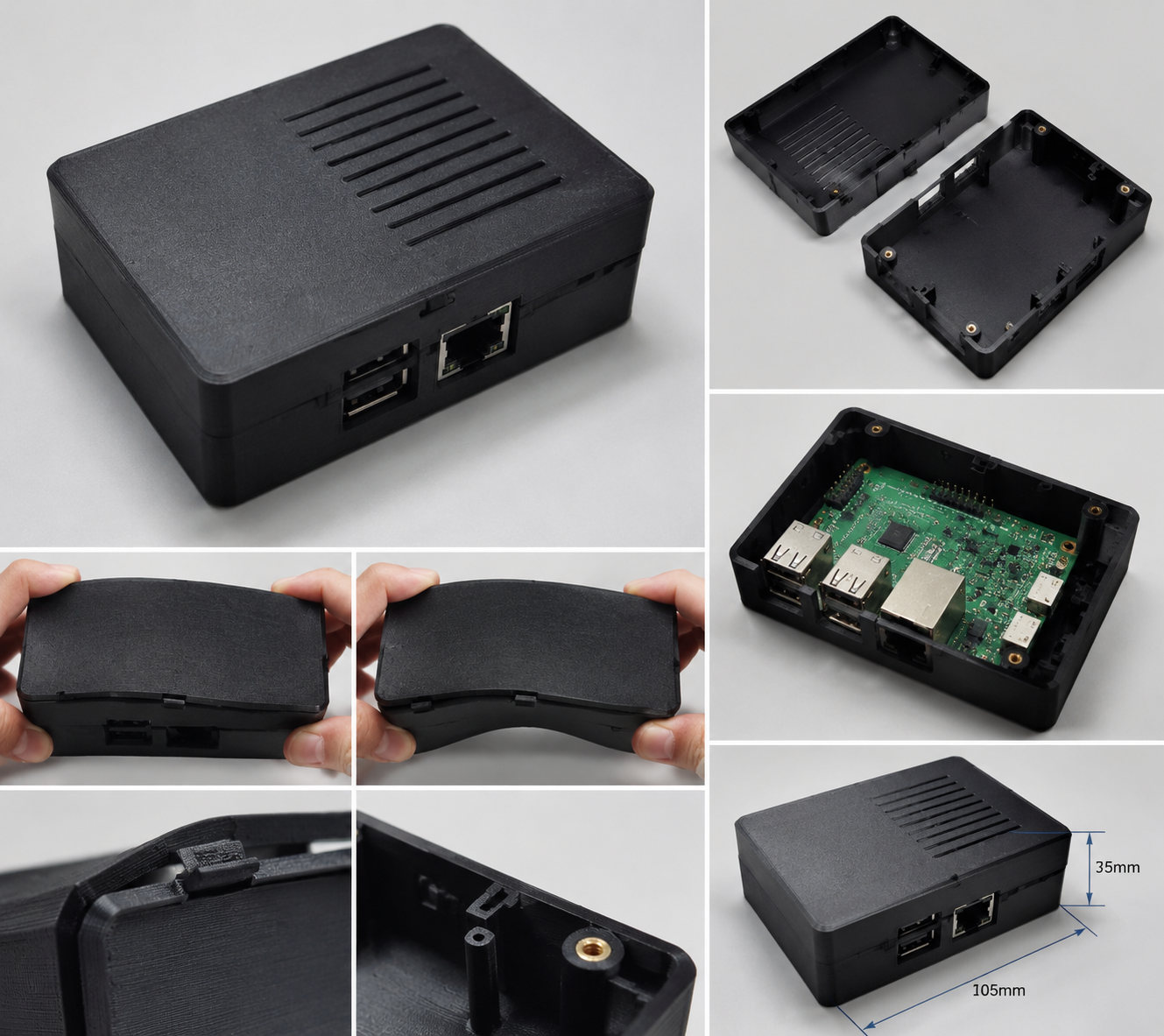
El ABS permite fabricar prototipos funcionales que tienen el mismo tacto y comportamiento que las piezas moldeadas por inyección destinadas a la producción. Los sistemas de encaje a presión funcionan bien con el ABS porque la combinación de rigidez y resistencia al impacto de este material permite que los clips y las lengüetas se flexionen sin romperse, algo que el PLA no puede hacer de forma fiable. Las cajas de componentes electrónicos, las carcasas de herramientas y los prototipos de productos de consumo se benefician de la dureza superficial del ABS y de su resistencia a las abolladuras y los arañazos.
Piezas de uso final en entornos controlados
El ABS es uno de los pocos materiales FDM aptos para la fabricación de piezas destinadas al uso final, especialmente para aplicaciones en interiores. Sus propiedades mecánicas están bien caracterizadas, se conoce su comportamiento de fluencia a largo plazo y su resistencia a la fatiga es adecuada para numerosas aplicaciones estructurales. Las granjas de impresión que fabrican piezas de ABS para productos de consumo, equipos industriales y carcasas de dispositivos médicos demuestran que el ABS es apto para la producción cuando la impresora y el entorno están correctamente configurados.
Piezas que requieren un tratamiento posterior
Si tu proceso de trabajo incluye lijado, imprimación, pintura o galvanizado, es probable que el ABS sea el mejor material FDM disponible. Su comportamiento al lijado es superior al del PLA —que obstruye el papel de lija— y al del PETG —que es demasiado resistente para lijarlo de forma eficaz—. Su compatibilidad química con las pinturas y las imprimaciones para automoción es excelente. Además, su capacidad para ser galvanizado —un proceso en el que se deposita una capa de níquel o cobre no electrolítico sobre la superficie del ABS para hacerla conductora, seguido de una galvanización convencional— abre nuevas posibilidades de aplicación para piezas con aspecto metálico a una fracción del coste de la impresión 3D en metal.

Deformación: comprender y eliminar el problema de fondo
La deformación del ABS es un problema de expansión térmica, no de adhesión. El coeficiente de expansión térmica (CTE) del material es de aproximadamente 80-110 µm/m·°C, y la contracción desde la temperatura de impresión hasta la temperatura ambiente es de aproximadamente 0,4-0,8% en el plano X-Y. Si esta contracción se produce de forma no uniforme —porque la parte inferior de la pieza se mantiene a 100 °C mientras que la parte superior se enfría por debajo de la Tg—, la tensión resultante se concentra en la interfaz con la cama y la pieza se despega.
Las soluciones para la deformación del ABS, por orden de eficacia:
- Caja a 40-60 °C: Reduce el gradiente térmico a lo largo de la altura de la pieza, lo que permite que la contracción se produzca de forma más uniforme. Esta es la medida más eficaz para evitar la deformación.
- Lecho a 100-110 °C: Mantiene las capas inferiores por encima de la Tg durante toda la impresión, lo que evita la solidificación prematura y la tensión de contracción resultante.
- Bordes y discos auxiliares: Un reborde de 5-10 mm aumenta la superficie de adhesión y desplaza la concentración de tensiones hacia fuera del perímetro de la pieza. En el caso de las piezas con esquinas afiladas, la incorporación de discos auxiliares cilíndricos (de 5-10 mm de diámetro y un espesor equivalente a una capa) en cada esquina disipa la concentración de tensiones.
- Esquinas redondeadas en el diseño: Las esquinas afiladas concentran la tensión. Un radio de entre 2 y 5 mm en todas las esquinas reduce drásticamente la tensión local en la interfaz con la base y, a menudo, marca la diferencia entre una impresión satisfactoria y una deformada, sin necesidad de modificar ningún ajuste de la impresora.
- Precalentamiento de la cámara: Deja que la cámara alcance los 40 °C antes de iniciar la impresión, encendiendo la cama calefactada durante 10-15 minutos. Iniciar la impresión con la cámara fría hace que las primeras capas se enfríen rápidamente mientras la cámara se calienta poco a poco, lo que provoca precisamente el comportamiento térmico que causa la deformación.
ASA frente a ABS: cuándo cambiar a un sistema más avanzado
El ASA (acrilonitrilo-estireno-acrilato) es químicamente similar al ABS, pero sustituye la fase de caucho de butadieno por una de caucho de acrilato. Esta sustitución elimina los dobles enlaces de la cadena principal del polímero que hacen que el butadieno sea vulnerable a la degradación por rayos UV y a la oxidación. El resultado es un material que se imprime de forma idéntica al ABS —mismas temperaturas, mismos requisitos de recinto, mismas estrategias de adhesión a la cama— pero con una resistencia a los rayos UV, un comportamiento frente a la intemperie y una estabilidad del color notablemente mejores.
Para aplicaciones en exteriores, el ASA es indiscutiblemente superior al ABS. El ABS expuesto a la luz solar se amarillea, se vuelve quebradizo y pierde resistencia al impacto en cuestión de meses. El ASA mantiene sus propiedades mecánicas y su color tras años de exposición al aire libre. Para aplicaciones en interiores, el ABS y el ASA son funcionalmente equivalentes, y el coste del ABS, normalmente más bajo ($20-35/kg frente a $30-45/kg para el ASA), lo convierte en la opción predeterminada, a menos que se prevea exposición a los rayos UV.

Salud y seguridad: la verdad sobre los vapores del ABS
El ABS emite compuestos orgánicos volátiles (COV) y partículas ultrafinas (UFP) durante la impresión. El principal COV es el estireno —el mismo monómero que da nombre al ABS y le confiere su olor característico—, junto con cantidades menores de acrilonitrilo, etilbenceno y otros productos de descomposición térmica. El estireno está clasificado como posible carcinógeno humano (Grupo 2B de la IARC), y el acrilonitrilo está clasificado como probable carcinógeno humano (Grupo 2A de la IARC).
El riesgo práctico derivado de la impresión ocasional con ABS en un espacio ventilado es bajo. Las tasas de emisión de una sola impresora FDM están varios órdenes de magnitud por debajo de los límites de exposición laboral. Sin embargo, en un centro de impresión con varias impresoras de ABS funcionando de forma continua, la acumulación de COV puede alcanzar niveles que justifiquen una ventilación activa y la filtración del aire. Un sistema de filtración HEPA y de carbón activo —ya sea integrado en la cabina o como purificador de aire independiente para la sala— elimina tanto las partículas ultrafinas (UFP) como los COV generados por la impresión con ABS.
La cabina tiene una doble función: retiene el calor para garantizar la calidad de impresión y contiene los humos por motivos de seguridad. Una cabina sellada con un sistema de extracción filtrado —incluso un simple ventilador que expulse el aire a través de una ventana— resuelve ambos problemas a la vez.
¿Es el ABS adecuado para tu aplicación?
El ABS es la opción adecuada cuando tu aplicación requiere una resistencia al calor superior a 80 °C, una resistencia al impacto que el PLA no puede ofrecer, flexibilidad en el posprocesado (lijado, pintado, alisado al vapor) o propiedades del material que se ajusten a las de las piezas de ABS moldeadas por inyección para la producción, con el fin de crear prototipos. No es la opción adecuada cuando la principal preocupación es la facilidad de impresión (utiliza PLA o PETG), cuando se prevé exposición a los rayos UV (utiliza ASA), cuando se requiere resistencia química a los disolventes (utiliza PP o nailon) o cuando el único equipo disponible es una impresora al aire libre sin carcasa.
Tanto para el ingeniero que necesita piezas funcionales capaces de resistir las altas temperaturas del interior de un coche, como para el diseñador de productos que necesita prototipos con el mismo tacto que las piezas de serie, o para el fabricante que necesita componentes para uso final con propiedades mecánicas bien caracterizadas, el ABS sigue siendo —tras más de una década de innovación en materia de filamentos— uno de los materiales FDM más eficaces y rentables del mercado.

Preguntas frecuentes
¿Puedo imprimir ABS sin cámara de impresión?
Sí, pero con limitaciones importantes. Las piezas pequeñas de menos de 50 mm en cualquiera de sus dimensiones se pueden imprimir sin cámara cerrada si se optimiza la adhesión a la plataforma y se eliminan las corrientes de aire del entorno. Las piezas medianas (entre 50 y 100 mm) son un caso límite: el éxito depende en gran medida de la geometría de la pieza, y las formas redondeadas y con baja relación de aspecto se conservan mejor que las altas y angulosas. Las piezas grandes de más de 100 mm se deformarán casi con toda seguridad sin una cámara de impresión. Una cámara temporal —una caja de cartón colocada sobre la impresora, una caja de luz fotográfica o incluso una bolsa de basura— es suficiente para impresiones ocasionales en ABS y no cuesta prácticamente nada. Si tienes pensado imprimir en ABS con regularidad, invierte en una cámara de impresión adecuada.
¿Por qué se deforma mi impresión de ABS incluso con una cama calefactada?
Una cama calefactada por sí sola no es suficiente para el ABS: la cama mantiene calientes las capas inferiores, pero las superiores se enfrían rápidamente al aire libre, lo que crea un gradiente térmico que provoca deformaciones. La cámara de impresión es la pieza que falta. Además, comprueba que la temperatura de la cama alcance realmente los 100-110 °C en la superficie (no solo en el termistor), que la superficie de la cama esté correctamente preparada (PEI limpio, Kapton nuevo o pasta de ABS) y que la primera capa esté bien aplastada — el ABS necesita una mayor compresión en la primera capa que el PLA para lograr una superficie de contacto adecuada con la cama. Una altura de primera capa de 0,20 mm con una boquilla de 0,40 mm, con un ancho de extrusión de 105-110%, proporciona la compresión y la superficie necesarias para una adhesión fiable.
¿Cómo puedo alisar el ABS con vapor de acetona de forma segura?
Requisitos de seguridad: trabajar al aire libre o en un lugar bien ventilado, utilizar un recipiente hermético de cristal o metal (la acetona disuelve muchos plásticos), evitar cualquier fuente de ignición (llamas piloto, chispas, electricidad estática) y llevar guantes de nitrilo (la acetona penetra en el látex). Procedimiento: vierta una pequeña cantidad de acetona (5-10 ml) en el fondo del recipiente, coloque la pieza sobre una rejilla metálica o papel de aluminio suspendida sobre el líquido, cierre herméticamente el recipiente y espere. A temperatura ambiente, en 1-2 horas se obtiene una superficie brillante. Para obtener resultados más rápidos, calienta el recipiente a 40-50 °C —un baño de agua caliente sirve para ello—, lo que reduce el tiempo de tratamiento a 15-30 minutos. Tras el alisado, deja que la pieza se desgasifique durante 24 horas antes de manipularla en profundidad; la superficie permanece blanda y pegajosa inmediatamente después de retirarla y adquiere su dureza total a medida que la acetona residual se difunde hacia el exterior.
ABS frente a PETG: ¿cuál debería elegir?
El PETG es más fácil de imprimir —no requiere cámara cerrada, se deforma menos y no desprende olores—, pero es menos resistente al calor (70 °C frente a los 95 °C de HDT), tiene menor dureza superficial y ofrece menos posibilidades de posprocesado en comparación con el ABS. Elige el PETG cuando la facilidad de impresión y la resistencia al impacto sean más importantes que la resistencia a la temperatura. Elige el ABS cuando la pieza vaya a estar expuesta a temperaturas superiores a 70 °C, cuando se prevea un posprocesado (lijado, pintado, alisado al vapor) o cuando se requiera la mayor rigidez y dureza superficial del ABS. Para piezas funcionales de uso en interiores, el ABS suele ser el material de mayor rendimiento, a costa de un proceso de impresión más exigente.