Low-Volume Injection Molding: The Engineering Answer
Low-volume injection molding is a production route for molded plastic parts when demand is too high for practical prototype production but too low, uncertain, or time-sensitive for a fully optimized production mold. Typical programs include pilot launches, pre-production validation, bridge production, replacement parts, regulated verification builds, and specialized products with stable but limited annual demand.
The quantity alone does not select the process. Engineers should evaluate annual demand, resin abrasiveness, part geometry, tolerance stability, required mold life, launch timing, design-change risk, and the cost of delaying market entry. A 2,000-part unfilled ABS housing may fit an aluminum mold, while the same quantity in glass-filled PA66 may justify P20 steel because fiber wear can damage a softer cavity before the program is complete.
| Program Condition | Likely Manufacturing Route | Engineering Reason |
|---|---|---|
| Several functional parts or frequent design changes | 3D printing or CNC machining | No mold investment; geometry can change between builds. |
| Hundreds to several thousand molded parts | Aluminum, soft-steel, or modular insert tooling | Production resin and molded geometry are required without full production-tool investment. |
| Launch inventory needed before the production mold is ready | Bridge tooling operated in parallel with production-tool build | Initial demand is supplied while the hardened, higher-cavity mold is manufactured and qualified. |
| Stable forecast with high lifetime demand | Production steel tooling | Higher tooling cost can be recovered through longer life, more cavities, automation, and lower recurring cost. |
Use these ranges as a screening tool, not a purchasing specification. The final route should be confirmed through DFM, mold-life assumptions, a documented quality plan, and a total-program-cost comparison.
What Is Low-Volume Injection Molding?
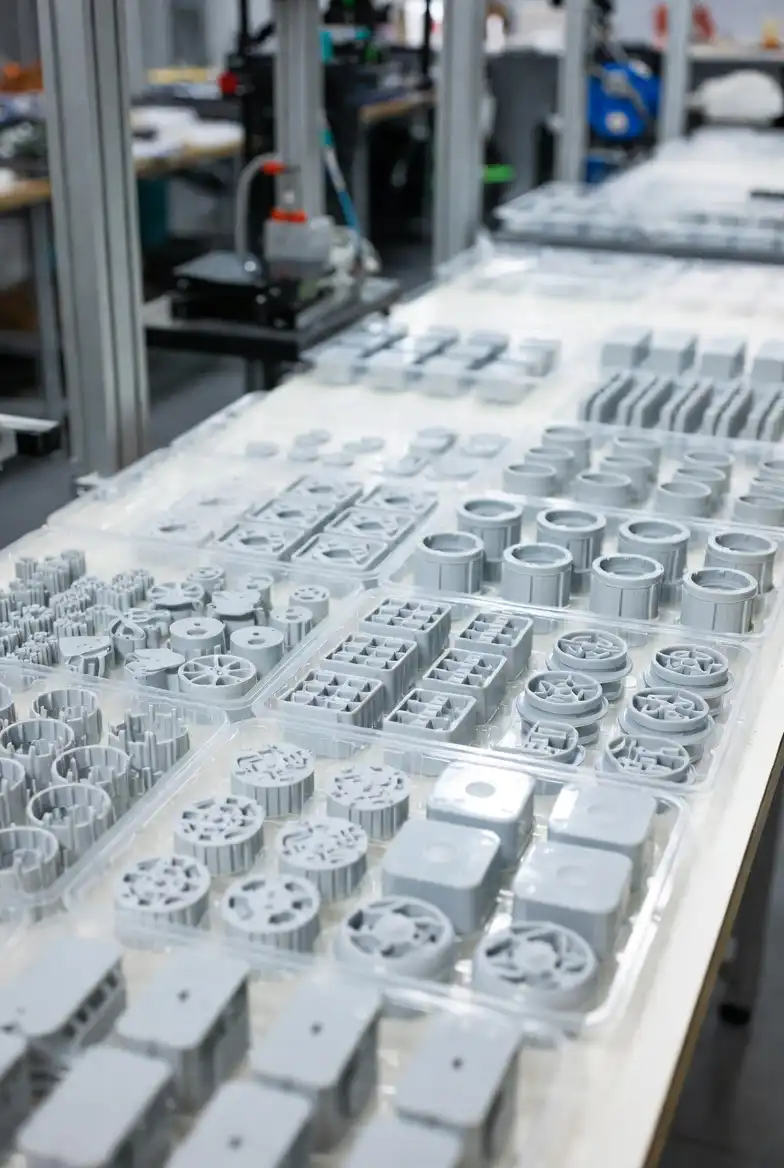
Low-volume injection molding refers to the production of plastic parts in quantities typically ranging from 100 to 10,000 units per run. Unlike mass production tooling designed for hundreds of thousands or millions of cycles, low-volume molding employs specialized approaches to bridge the gap between prototyping and full-scale manufacturing. This production strategy is especially relevant for product validation testing, bridge tooling during design iterations, market pilot launches, replacement parts for legacy equipment, and niche industrial applications where annual demand never justifies high-volume tooling investment.
The defining characteristic of low-volume injection molding is the use of lower-cost mold materials and streamlined manufacturing methodologies. While production-grade molds fabricated from hardened tool steel can cost $50,000 to $150,000 or more, low-volume mold options can reduce tooling expenditure by 50% to 70%. The trade-off is mold longevity — a low-volume mold may reliably produce 100 to 100,000 shots versus a production mold rated for one million or more cycles. For the right application, this trade-off delivers compelling economics.
Mold Technologies for Low-Volume Production
Selecting the appropriate mold technology is the single most important decision in low-volume injection molding. The following options represent the primary pathways, each with distinct cost, lead time, and quality profiles.

Aluminum Prototype Molds
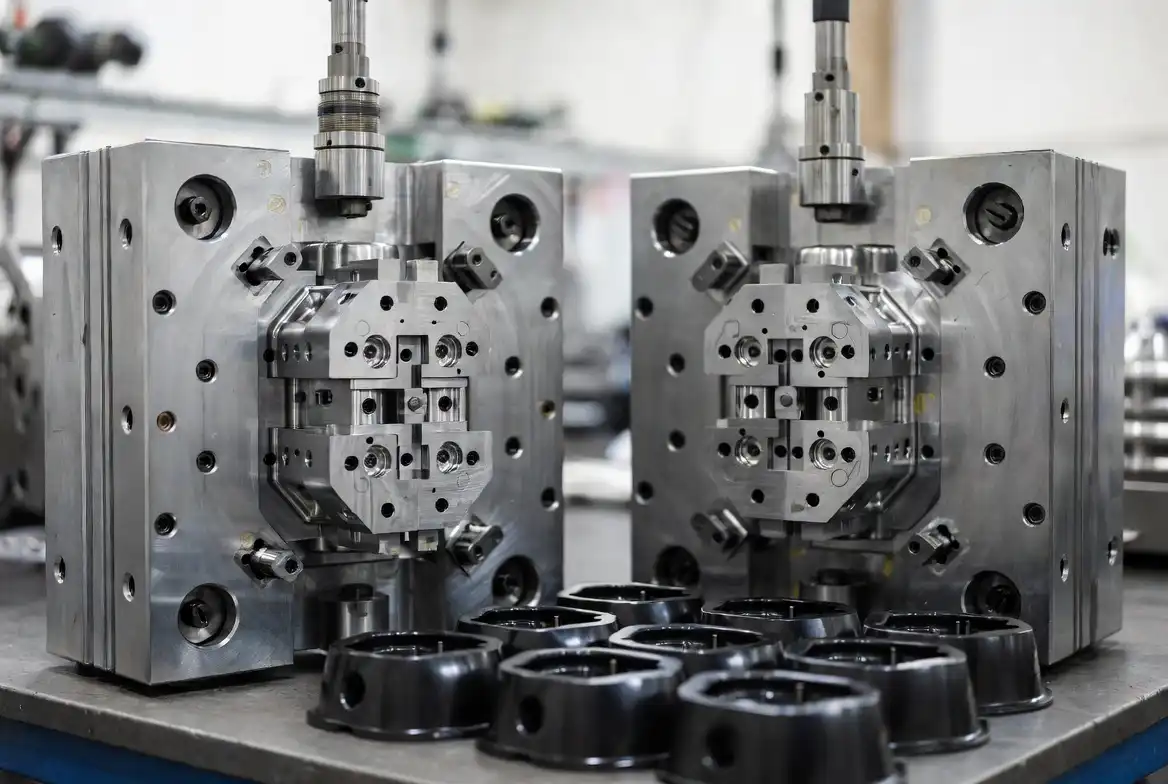
Aluminum molds are the workhorse of low-volume injection molding. Tool-grade aluminum alloys such as 7075-T6 and QC-10 offer excellent machinability, reducing mold fabrication time by 30% to 50% compared to steel. Aluminum’s superior thermal conductivity — approximately four times that of tool steel — enables faster cycle times and more uniform cooling, which can improve part quality by reducing warpage and sink marks. Typical aluminum molds are rated for 1,000 to 100,000 shots depending on the resin, part geometry, and maintenance. They are best suited for unfilled thermoplastics; glass-filled resins accelerate wear on aluminum cavities due to abrasive fiber content.
A standard aluminum mold for a part of moderate complexity can be fabricated in 2 to 4 weeks at a cost ranging from $3,000 to $15,000. The combination of rapid turnaround and moderate cost makes aluminum the default choice for most low-volume injection molding programs.
Steel Prototype Molds (P20/H13)
When production volumes exceed 50,000 units or when processing abrasive materials such as glass-filled nylon (PA66-GF30) or high-temperature resins like PEEK, pre-hardened steel molds become necessary. P20 steel, hardened to approximately 28-32 HRC, provides a middle ground — significantly more durable than aluminum while costing less than fully hardened production tooling. Typical lead times for P20 prototype molds range from 4 to 8 weeks, with costs of $8,000 to $30,000 for moderately complex parts.
Steel prototype molds also support higher injection pressures and can accommodate more complex gating arrangements, including hot runner systems that are impractical or impossible in aluminum. For parts requiring tight tolerances across the entire production run, the dimensional stability of steel provides a meaningful advantage over aluminum, which exhibits greater thermal expansion and can show measurable wear after several thousand cycles of abrasive materials.
MUD (Master Unit Die) Frame Systems
MUD mold frame systems offer a compelling middle ground for low-volume production. In a MUD system, a standardized, reusable steel frame houses interchangeable insert sets that contain the actual cavity and core geometry. The frame — a significant capital investment at $10,000 to $25,000 — is a one-time purchase. Each new part design requires only the fabrication of new insert sets, which typically cost $1,500 to $8,000 per set and can be produced in 1 to 3 weeks.
For manufacturers running multiple low-volume parts, the economics of MUD systems are transformative. A single MUD frame amortized across ten insert sets reduces per-part tooling cost by 40% to 60% compared to building complete molds for each design. MUD systems are particularly popular in the automotive and medical device industries, where frequent design changes and moderate volumes are the norm. The primary limitation is part size — MUD frames impose maximum envelope dimensions, typically around 200 mm x 250 mm in cavity area.
Family Molds for Cost Sharing
A family mold combines cavities for multiple different parts within a single mold base. This approach is most effective when the parts share similar wall thickness, material, and projected area so that filling is balanced. Family molds can reduce total tooling cost by 30% to 50% compared to building separate molds for each component. However, they introduce manufacturing complexity: if one cavity requires maintenance, the entire mold comes out of production; if parts have significantly different volumes, one cavity runs unnecessarily; and achieving balanced filling across dissimilar cavities demands sophisticated runner design and possibly different gate sizes.
Family molds work best when the combined parts are always needed in the same ratio — for example, a left and right housing pair, or a base and lid that ship together as an assembly.
Cost Breakdown: Low-Volume vs. High-Volume Injection Molding
| Factor de coste | Low-Volume (Aluminum Mold, 5,000 Units) | High-Volume (Hardened Steel, 500,000 Units) |
|---|---|---|
| Mold Fabrication | $5,000 – $15,000 | $50,000 – $150,000 |
| Mold Lead Time | 2 – 4 weeks | 8 – 16 weeks |
| Unit Part Cost | $2.50 – $8.00 | $0.30 – $1.50 |
| Amortized Tooling per Part | $1.00 – $3.00 | $0.10 – $0.30 |
| Total Cost per Part (Tooling + Unit) | $3.50 – $11.00 | $0.40 – $1.80 |
| Lo mejor para | Prototypes, pilot runs, niche products, bridge tooling | Consumer goods, automotive production, high-volume industrial |
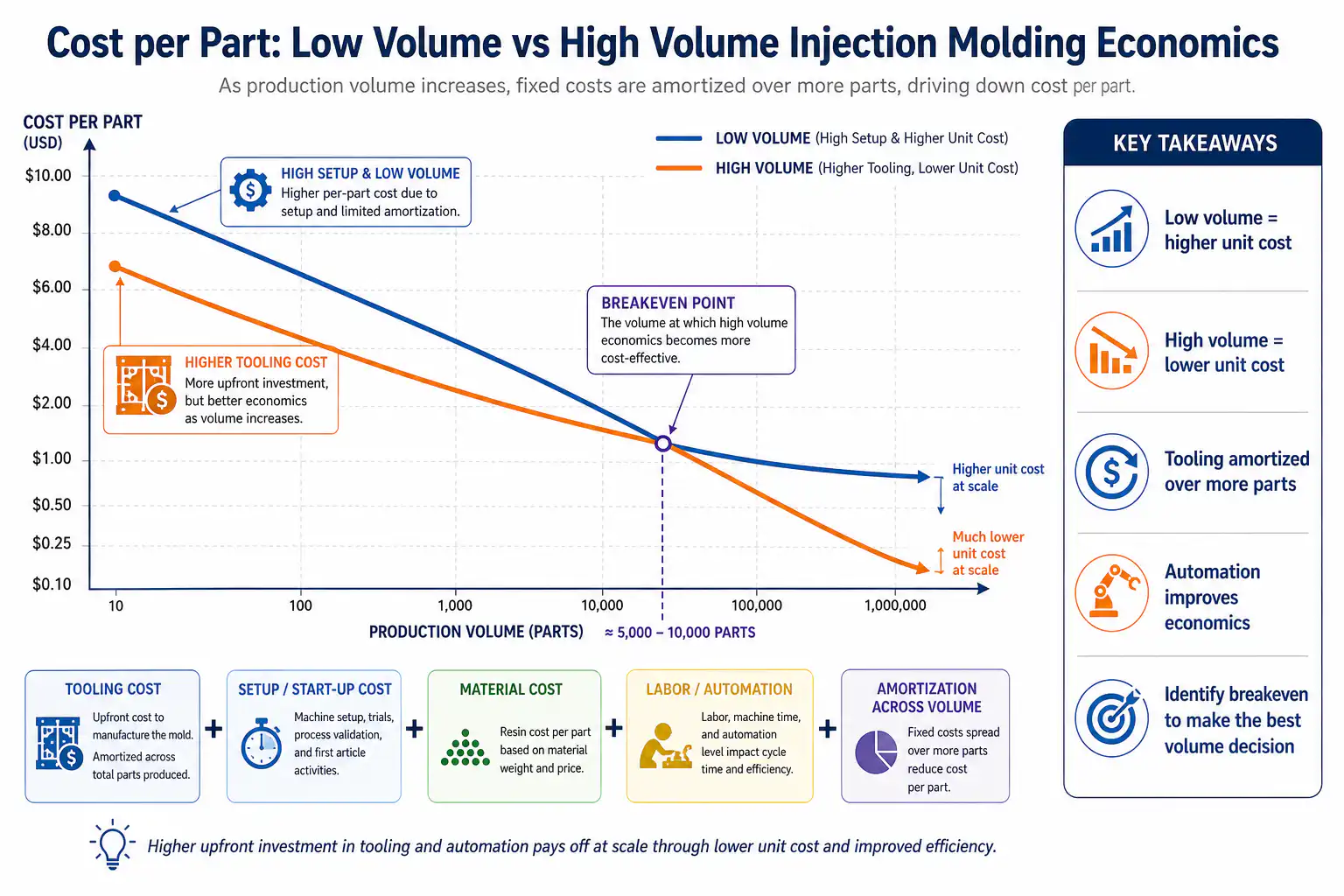
This comparison illustrates a fundamental economic principle of injection molding: mold cost amortization dominates unit economics at low volumes, while unit part cost dominates at high volumes. The crossover point — where high-volume tooling becomes economically justified — varies by part complexity and material but typically falls between 20,000 and 100,000 units. Below this threshold, low-volume strategies deliver superior total cost of ownership.
Lead Time Expectations and Project Planning
Lead time is often the primary driver behind low-volume injection molding decisions. When a product launch deadline looms or when design iterations demand rapid turnaround, the compressed schedule of prototype tooling becomes a strategic advantage. Below are typical lead time ranges for low-volume injection molding projects:
| Project Phase | Aluminum Mold | P20 Steel Mold | MUD Insert Set |
|---|---|---|---|
| DFM Review and Mold Design | 3 – 5 days | 5 – 10 days | 3 – 5 days |
| Mold Fabrication | 10 – 20 days | 20 – 40 days | 7 – 14 days |
| Mold Trial (T0 Sampling) | 1 – 2 days | 1 – 3 days | 1 – 2 days |
| Mold Adjustments and T1 | 3 – 7 days | 5 – 10 days | 2 – 5 days |
| Production Run (5,000 units) | 2 – 5 days | 3 – 7 days | 3 – 5 days |
| Total Estimated Timeline | 4 – 6 weeks | 7 – 12 weeks | 3 – 5 weeks |
These timelines assume standard part complexity and availability of mold base components. Complex parts with side actions, unscrewing cores, or intricate cooling channels will extend each phase. Expedited schedules are possible at additional cost — rush charges for mold fabrication typically add 30% to 50% to the tooling price but can compress the mold build phase by 30% to 40%.
When to Use Alternatives: 3D Printing and CNC Machining
Low-volume injection molding is not always the optimal solution. For quantities below 100 units, additive manufacturing (3D printing) or CNC machining often provides better economics and faster turnaround. The decision framework should consider the following factors.
3D printing is appropriate when quantities are below 50 to 100 units, when geometric complexity exceeds what is moldable, when design iterations are ongoing and tooling investment cannot yet be justified, or when lead time must be compressed to days rather than weeks. Technologies such as selective laser sintering (SLS) for nylon parts, Multi Jet Fusion (MJF) for production-grade PA12, and stereolithography (SLA) for high-detail visual prototypes are the most common choices for functional low-volume production.
CNC machining is the superior choice when material properties must match production intent exactly (3D-printed parts rarely match the mechanical properties of injection-molded equivalents), when tight tolerances of plus or minus 0.05 mm or better are required, when the part is predominantly prismatic and machining access is straightforward, or when quantities fall between 50 and 500 units where machining cycle time remains competitive. CNC machining avoids all tooling cost but unit costs are substantially higher — typically $15 to $150 per part depending on complexity — and do not decline with volume.
| Factor decisivo | Impresión 3D | Mecanizado CNC | Low-Volume Injection Molding |
|---|---|---|---|
| Optimal Quantity Range | 1 – 100 units | 10 – 500 units | 100 – 10,000 units |
| Tooling Required | Ninguno | None (fixtures only) | Yes ($3,000 – $30,000) |
| Propiedades de los materiales | Anisotropic, limited to printable resins | Isotropic, any machinable plastic | Isotropic, full resin selection |
| Acabado superficial | Layered texture, requires post-processing | Machined finish, polishable | Mold finish transfer, texture options |
| Lead Time (First Parts) | 1 – 5 days | 3 – 10 days | 14 – 30 days |
Bridge Tooling Strategy
Bridge tooling is a strategic approach that uses low-volume molds to begin production while the full production tooling is still being fabricated. This strategy is particularly valuable in the automotive, medical device, and consumer electronics industries, where time-to-market pressure is intense and production tooling lead times of 12 to 20 weeks can jeopardize launch schedules.
A typical bridge tooling program proceeds as follows: the aluminum or P20 bridge mold is designed and fabricated in 3 to 6 weeks. Production of initial market inventory begins immediately upon mold qualification, generating revenue and building market presence while the hardened production mold is built over 10 to 16 weeks. When the production mold is qualified, the bridge mold is either retired or retained as a backup for capacity surges and replacement part production.
The financial case for bridge tooling is straightforward: the additional tooling investment — typically $5,000 to $20,000 — is weighed against the revenue loss and market share erosion of delaying product launch by 8 to 12 weeks. For most commercial products, this calculation strongly favors the bridge approach. A bridge mold producing 5,000 to 20,000 units during the transition period typically pays for itself several times over in accelerated revenue capture.
Quality Considerations in Low-Volume Molding
Low-volume does not mean low-quality. Parts produced from aluminum prototype molds can meet the same dimensional and cosmetic standards as parts from production tooling, provided the mold is properly designed and maintained. Key quality factors include uniform cooling channel design to minimize warpage, adequate venting to prevent burn marks and short shots, proper draft angles of 1 to 3 degrees to ensure clean ejection without drag marks, and gate location optimization to control knit line placement and minimize visible flow marks.
Process validation for low-volume production should include first-article inspection (FAI) per AS9102 or equivalent standards, capability studies (Cp/Cpk) on critical-to-quality dimensions, and material certification including melt flow index verification and, where applicable, UL 94 flammability rating confirmation. These validation steps establish that the low-volume process produces conforming parts and provide baseline data for any future transition to high-volume production.
Case Example: Automotive Sensor Housing
A Tier 1 automotive supplier required 8,000 injection-molded sensor housings in glass-filled PA66 for a pre-production vehicle validation program. Full production tooling — a hardened S136 steel mold with hot runner system — was quoted at $85,000 with a 14-week lead time. The bridge strategy employed an aluminum mold at $12,000 with a 4-week lead time, producing the full 8,000-unit requirement over 10 days of molding. Total cost including tooling and production was approximately $38,000. The alternative — delaying the program by 10 weeks and proceeding directly to production tooling — would have incurred program delay penalties exceeding $100,000 and jeopardized the supplier relationship. The bridge mold successfully produced all required parts within specification and was retained for service part production.
When to Move from Low-Volume to Production Tooling
The transition should be based on total program economics and process risk, not on a universal order quantity. A low-cost mold remains useful while it can maintain dimensional, cosmetic, and delivery requirements. Production tooling becomes the better route when higher output, lower unit cost, longer unattended runs, tighter process capability, or extended service life offsets the additional mold investment.
Calculate the Break-Even Quantity
A practical first calculation is:
Break-even quantity = (production-tool cost – low-volume-tool cost) / (low-volume unit cost – production unit cost).
Assume an aluminum tool costs $10,000 and produces parts at $2.40 each, while a multi-cavity steel tool costs $35,000 and produces parts at $1.10 each. The additional tooling investment is $25,000 and the recurring saving is $1.30 per part. The simplified break-even point is approximately 19,231 parts. The sourcing decision should then add qualification, maintenance, resin waste, freight, inventory carrying cost, and the financial impact of lead time. If the design is likely to change before that volume is reached, staying with the lower-investment tool may still be the lower-risk decision.
Production-Tooling Triggers
- Forecast confidence: released orders and credible annual demand exceed the remaining economic life of the current mold.
- Capacity pressure: a single cavity or manually operated tool cannot meet weekly demand without overtime, excess inventory, or delivery risk.
- Wear or drift: flash, gate wear, texture loss, dimensional movement, or rising maintenance frequency shows that the bridge tool is approaching its practical limit.
- Quality requirement: the program now requires stronger cavity-to-cavity consistency, automated inspection, documented capability, PPAP, or a more controlled thermal system.
- Unit-cost leverage: multiple cavities, a hot runner, automation, or shorter cycle time creates enough recurring saving to recover the higher tooling cost.
- Supply continuity: the bridge mold must become a backup while a production tool carries normal demand.
Begin production-tool planning before the bridge tool reaches its wear limit. Transfer the approved CAD revision, material grade, dimensional reports, process settings, defect history, maintenance log, and approved samples. That record gives the production toolmaker a validated baseline and reduces the chance of repeating gate, cooling, venting, shrinkage, or warpage corrections.
RFQ Checklist for Low-Volume Molded Parts
A useful low-volume quotation must separate tooling assumptions from recurring part cost. Send every supplier the same controlled inputs and require written exclusions.
- Design files: current STEP or Parasolid model plus a revision-controlled 2D drawing.
- Demand: first order, annual quantity, peak monthly requirement, program life, and expected design-change window.
- Material: exact resin manufacturer and grade where required, color, filler, flame rating, UV package, compliance needs, and regrind restriction.
- Critical requirements: datum scheme, CTQ dimensions, tolerances, cosmetic zones, texture, inserts, threads, assembly interfaces, and leak or load tests.
- Tool expectation: target mold life, cavity count, aluminum or steel preference, replaceable inserts, mold ownership, maintenance, storage, and transfer terms.
- Approval package: T0/T1 sample quantity, FAI report, material certificate, capability study, PPAP level, gauge plan, and approved-master-sample control.
- Delivered scope: degating, insert loading, assembly, marking, cleaning, packaging, freight, duty, and delivery term.
Before requesting a fixed tooling price, review gate location, draft, wall transitions, undercuts, shrinkage allowance, and tolerance allocation. The gate design guide, tool steel selection guide, tolerance stack-up guide, y rapid tooling versus production tooling guide provide the supporting engineering decisions. For normalized tooling and part-price comparison, use the Guía de costes del moldeo por inyección.
Request a Low-Volume Injection Molding Review
Send the CAD model, drawing, resin grade, first-order quantity, annual forecast, critical dimensions, and required delivery date. Nylon Plastic can review whether machining, aluminum tooling, P20 inserts, bridge tooling, or production tooling provides the most controlled route to qualified parts.
Preguntas frecuentes
¿Cuál es la cantidad mínima de pedido para el moldeo por inyección de bajo volumen?
La mayoría de los proveedores de moldeo por inyección de bajo volumen establecen una cantidad mínima de pedido de entre 100 y 500 unidades, dependiendo del tamaño y la complejidad de la pieza. Para cantidades inferiores a 100 unidades, la impresión 3D o el mecanizado CNC suelen resultar más rentables. El límite mínimo práctico viene determinado por el coste de preparación del molde, las cantidades mínimas de material y el tiempo necesario para estabilizar el proceso durante las primeras inyecciones. Algunos servicios especializados en moldeo por inyección rápido aceptan pedidos de tan solo 50 unidades, aunque el precio unitario en estas cantidades refleja la ineficiencia de las tiradas de producción extremadamente cortas.
¿Cómo se compara la vida útil de los moldes de aluminio con la de los de acero en la producción de bajo volumen?
Los moldes de aluminio suelen durar entre 1.000 y 100.000 inyecciones, dependiendo de la resina, los rellenos y la geometría de la pieza. Las resinas sin relleno, como el ABS, el polipropileno y el nailon sin relleno, provocan un desgaste mínimo, lo que permite que los moldes de aluminio alcancen el límite superior de este rango. Las resinas con relleno de vidrio, en particular el PA66-GF30 y el PPS-GF40, son abrasivas y aceleran el desgaste de la cavidad, lo que reduce la vida útil de los moldes de aluminio a un rango de entre 1.000 y 10.000 inyecciones. Los moldes de acero P20 preendurecido pueden producir de forma fiable entre 100 000 y 500 000 inyecciones, incluso con materiales abrasivos, lo que los convierte en la opción preferida cuando los requisitos de volumen superan las capacidades del aluminio o cuando se especifican rellenos abrasivos.
¿Se pueden aplicar texturas y acabados superficiales a los moldes de bajo volumen?
Yes. Aluminum molds support a range of surface finishes including Mold-Tech and Yick Sang texture standards up to approximately MT-11000 depth. However, the softer aluminum surface means texture durability is limited compared to steel. For fine textures (VDI 12-24 or MT-11010 and finer), aluminum performs well for the mold’s rated lifespan. Deep textures (VDI 33+ or MT-11300 and deeper) may degrade visibly within 5,000 to 10,000 cycles. Steel molds support the full range of textures with excellent durability. High-gloss polished finishes (SPI A-1 to A-3) are achievable on both aluminum and steel, though aluminum requires more frequent re-polishing to maintain the surface quality.
¿Cuál es la diferencia de coste entre fabricar un molde en China y hacerlo en el país?
La fabricación de moldes en China suele costar entre 30% y 50% menos que los moldes equivalentes fabricados en Norteamérica o Europa Occidental, con plazos de entrega que a menudo son entre 20% y 30% más cortos. Esta ventaja en cuanto a costes se extiende a todos los tipos de moldes: de aluminio, de acero P20 y herramientas de producción endurecidas. Un molde cuyo presupuesto en el mercado nacional sea de $25 000 podría tener un precio de entre $12 000 y $17 000 si se encarga a un fabricante de moldes chino cualificado. Sin embargo, los compradores deben tener en cuenta los gastos de envío internacional (normalmente entre $500 y $2,000 para el transporte de moldes), los aranceles de importación y el valor de la comunicación directa con los ingenieros. Trabajar con un fabricante consolidado y orientado a la exportación que cuente con ingenieros de proyecto que hablen inglés y mantenga la certificación ISO 9001 reduce significativamente los riesgos de comunicación y calidad asociados al utillaje extranjero.
¿Cómo puedo pasar de una producción de bajo volumen a una de alto volumen?
La estrategia de transición depende de la estrategia original de herramientas para bajos volúmenes. Si se ha utilizado un molde puente de aluminio, el molde de producción de acero suele encargarse en paralelo: el molde puente se encarga de la producción inicial mientras se fabrica el molde de producción. El molde de producción se somete al mismo proceso de cualificación (muestra T0, inspección dimensional, ajustes T1, validación del proceso) antes de que se retire el molde puente. Si el enfoque de bajo volumen utilizó insertos MUD, la transición puede consistir simplemente en producir juegos de insertos adicionales o en pasar de insertos de aluminio a insertos de acero dentro del mismo marco MUD. La clave para una transición fluida es la documentación exhaustiva del proceso de bajo volumen —perfiles de temperatura del molde, parámetros de inyección, datos dimensionales y cualquier problema de procesamiento encontrado— de modo que el molde de producción pueda validarse con respecto a una referencia de calidad conocida, en lugar de empezar desde cero.
Lecturas relacionadas
- Injection Molding Cost Guide: Tooling and Part Price
- Cómo reducir los plazos de entrega en el moldeo por inyección
- Guía para la conversión de metal a plástico
For broader DFM, material, tooling and production support, review our servicios de moldeo por inyección de plástico and send the part drawing, material requirements and expected quantity with the RFQ.