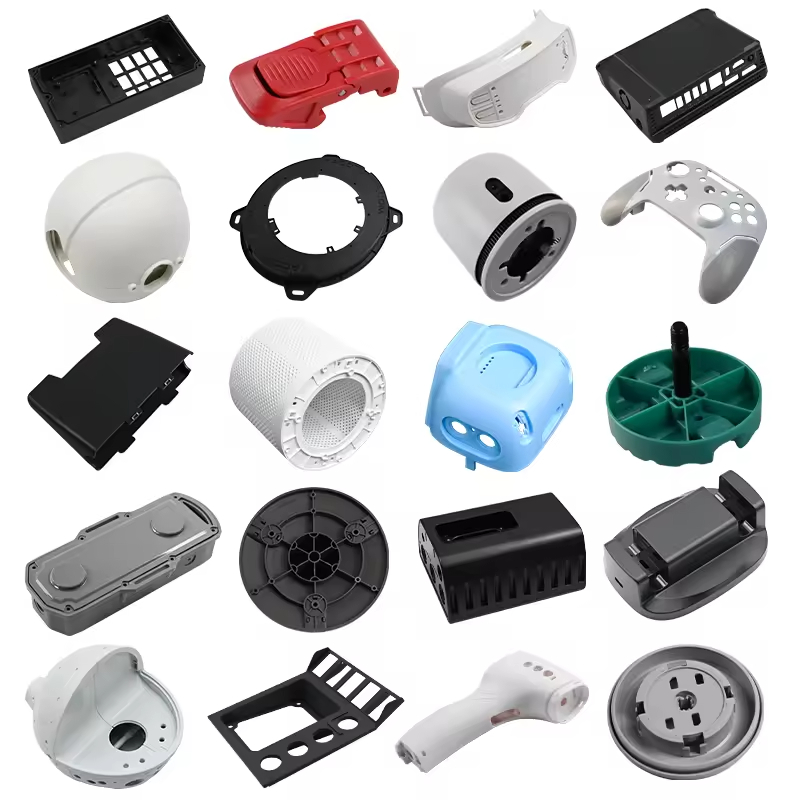
Sink marks in injection molding are shallow depressions on the part surface caused by uneven shrinkage, usually where thick walls, ribs, bosses, screw posts or heavy sections cool more slowly than surrounding material. Fixes usually require both DFM review and process tuning.
A molded part can pass basic dimensions and still fail visual inspection because of sink marks. For housings, covers, automotive trim and consumer-facing components, sink control should be planned before mold cutting through wall design, rib ratios, gate location and packing strategy.
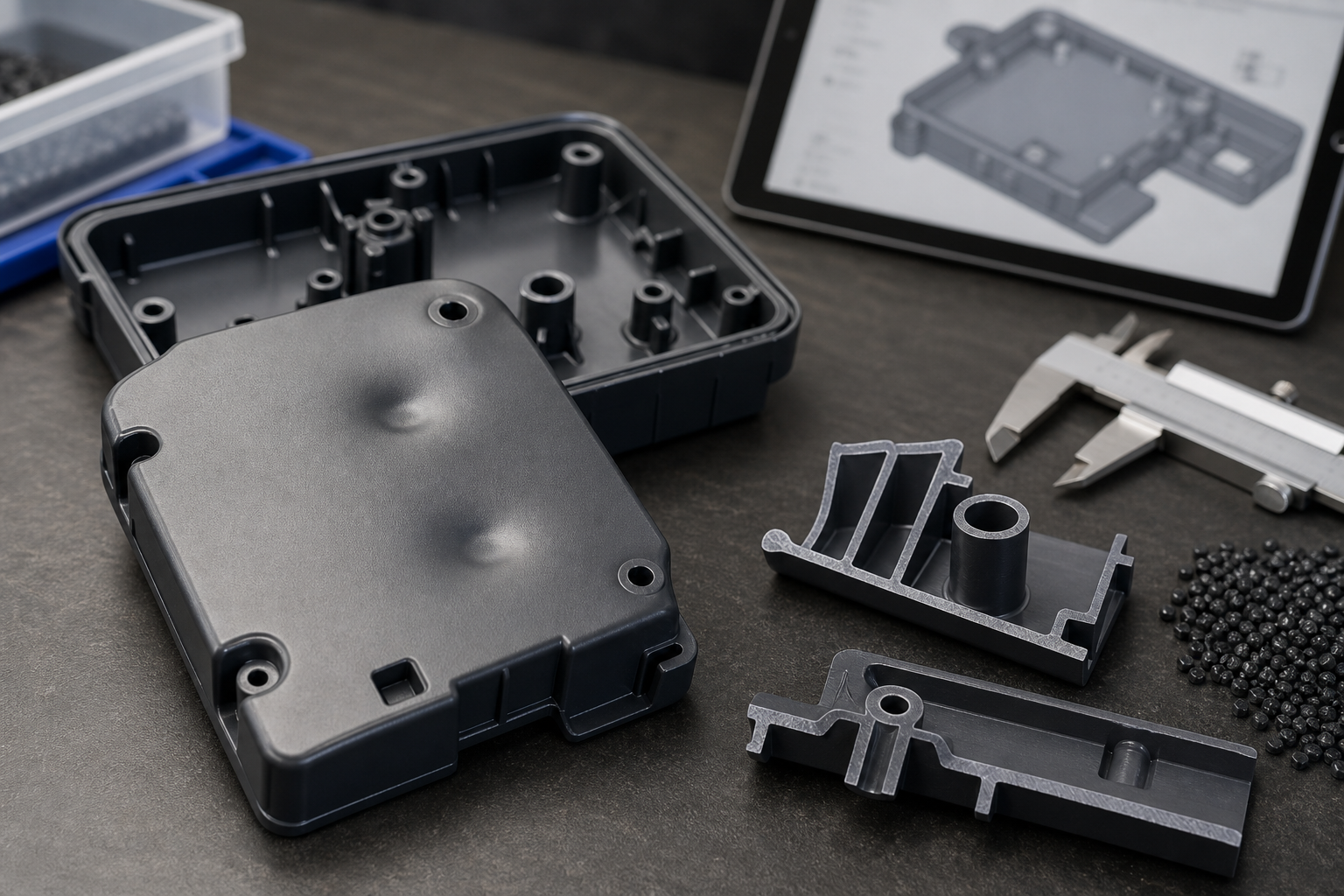
Common Causes of Sink Marks
| Causa / material | Señal o uso típico | Medidas del comprador o del departamento de ingeniería |
|---|---|---|
| Thick wall section | Surface depression over heavy mass | Core out thick areas and keep wall transitions gradual |
| Oversized ribs | Sink opposite rib base | Keep rib thickness lower than nominal wall |
| Heavy bosses | Circular sink on visible surface | Use support ribs and proper boss design |
| Gate freeze too early | Poor packing in thick zones | Review gate size, location and packing time |
| High shrinkage material | More visible sink on PP, PE or crystalline resins | Adjust DFM and shrinkage expectations by material |
DFM Checks Before Tooling
- Keep nominal wall thickness as uniform as practical.
- Avoid abrupt transitions from thin walls to heavy sections.
- Design ribs thinner than the main wall and add radius where needed.
- Core out bosses instead of leaving solid plastic masses.
- Place gates so thick zones can be packed before gate freeze.
Material Shrinkage and Sink Risk
| Material / caja | Principal motivo de preocupación | Nota sobre la selección |
|---|---|---|
| ABS | Moderate sink risk | Good for housings when ribs and bosses are designed correctly |
| PC / PC-ABS | Moderate risk | Cosmetic surfaces need stress and sink review |
| PP | Higher shrinkage | Control wall thickness and warpage together |
| POM | Crystalline shrinkage | Review precision features and packing |
| Glass-filled nylon | Fiber orientation and differential shrinkage | Check ribs, bosses and warpage |
Buyer RFQ Details for Sink Mark Prevention
Para que podamos realizar una revisión útil, envíanos el modelo 3D o el plano 2D, el tipo de resina o el material deseado, fotos de la pieza si el defecto ya está presente, información sobre la máquina y el molde (si está disponible), el volumen anual previsto, los requisitos estéticos, las dimensiones críticas, el entorno de aplicación y cualquier norma de inspección. Nylon Plastic puede revisar el diseño, el material y el proceso de moldeo antes de que se realicen cambios en el utillaje o en la producción.
Sink Mark Diagnosis by Feature
| Feature or Pattern | Why It Sinks | Design or Process Review |
|---|---|---|
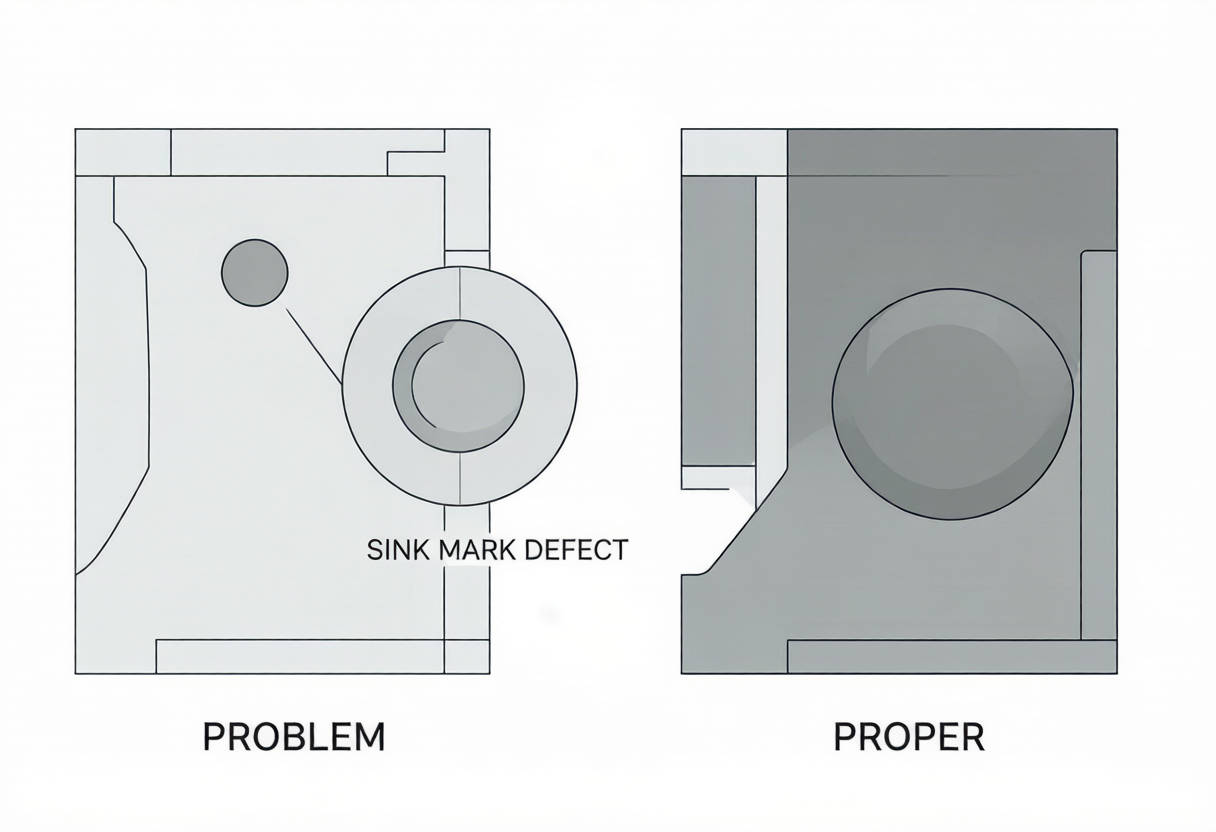
| Sink over a rib | Local mass cools later than the visible wall | Reduce rib ratio, hollow the section, and confirm packing access |
| Sink around a boss | Solid plastic around the post creates an uneven cooling section | Use a cored boss, adequate draft, and a controlled wall transition |
| Sink near the flow end | Pressure has decayed before the thick region is packed | Review gate location, runner balance, hold pressure and freeze time |
| Sink changes after material substitution | Shrinkage, viscosity, reinforcement and conditioning changed | Recheck the exact grade, filler direction, drying and shrinkage assumptions |
Higher packing pressure can hide a sink mark on one tool trial, but it may increase flash, stress, cycle time, or gate blush. A durable correction normally combines section design, gate access, cooling, material choice, and a validated packing window.
Cómo contribuye el plástico de nailon al proyecto
Nylon Plastic has supported material selection and finished plastic-part manufacturing since 2005. For sink mark prevention on molded plastic parts, the useful review connects the drawing, material, tooling or machining route, inspection state, and production plan before a quote is approved.
- Review the visible surface, rib and boss geometry, material shrinkage, gate location, and expected conditioning state before tooling.
- Compare unfilled PA with PA-GF20 or PA-CF30 only when the structural and dimensional requirements justify the change in flow and anisotropy.
- Use sample parts, measured wall sections, cavity records, and defined cosmetic limits to close the DFM decision.
Lecturas relacionadas
- Diseño del espesor de las paredes en el moldeo por inyección
- Ribs and Bosses DFM
- Piezas de plástico moldeadas a medida
Preguntas frecuentes
What causes sink marks in injection molding?
Sink marks usually come from uneven volumetric shrinkage in thick sections such as ribs, bosses, solid pads, or abrupt wall transitions. Packing, cooling, material, and gate access influence the result.
Can packing pressure remove sink marks?
It can reduce some sink marks when the gate remains open long enough, but excessive packing may create flash, stress, warpage, or a longer cycle. Correct the geometry and pressure window together.
Which materials are more sensitive to sink marks?
Every thermoplastic can show sink marks when section mass and cooling are poorly controlled. The exact grade, reinforcement, shrinkage, flow direction, and processing window should be checked rather than relying on a family label.
What should a sink mark DFM review include?
Provide the CAD model, wall and rib map, cosmetic zones, material or backup grade, gate concept, annual quantity, tolerance requirements, and photos or measurements of the defect.
Request a Sink Mark DFM Review
Send the part geometry, resin requirement, cosmetic zones, and target quantity for a design, tooling, and process review.