Comprender los sistemas de corredores
The runner system delivers molten plastic from the injection machine nozzle to the mold cavity. Choosing between hot runner and cold runner technology impacts part cost, quality, and production efficiency.
Sistemas de canales fríos
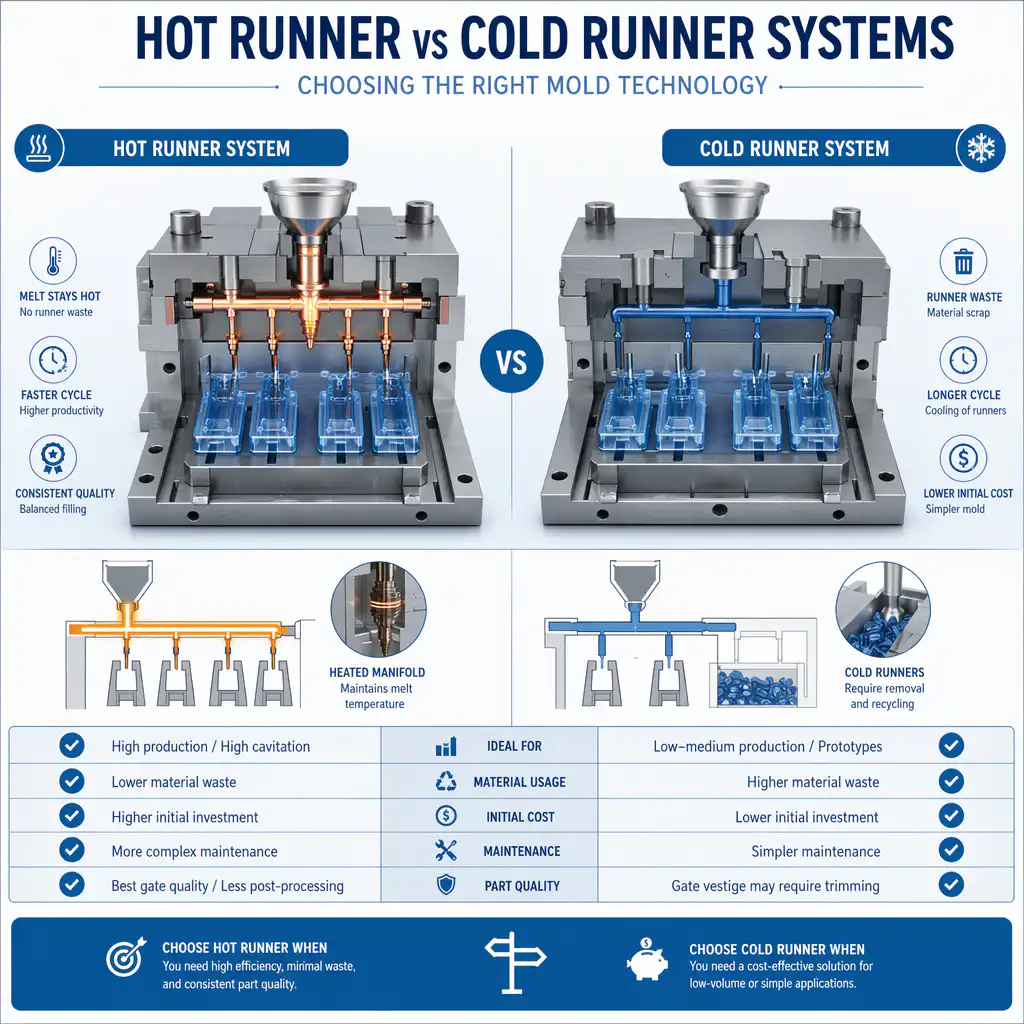
In cold runner molds, the runner channel is part of the mold cavity and solidifies with each cycle.
Ventajas
- Lower mold cost and simpler design
- Suitable for a wide range of materials
- Easy color changes
- No heated components to maintain
- Better for small production volumes
Disadvantages
- Runner waste (sprue, runners, gates)
- Longer cycle times due to runner cooling
- Post-molding degating required
- Higher material cost over time
Las mejores aplicaciones
- Low to medium volume production
- Multi-cavity molds with different part weights
- Materials sensitive to thermal degradation
- Frequent color changes
Sistemas de canal caliente
Hot runner systems maintain the runner in a molten state, eliminating solidified runner waste.
Ventajas
- No runner waste (material savings)
- Faster cycle times
- Lower injection pressure required
- Better for gate location flexibility
- Improved part quality at gates
Disadvantages
- Higher initial mold cost (30-50% more)
- More complex maintenance
- Potential for thermal degradation
- Not suitable for all materials
- Color change takes longer
Las mejores aplicaciones
- High-volume production
- Expensive engineering materials
- Large multi-cavity molds
- Parts requiring gate vestige control
Comparación de costes
Selection Guidelines
Elija Canal frío when:
- Production volume is low
- Budget constraints exist
- Frequent color changes required
- Material is heat-sensitive
Elija Canal caliente when:
- Production volume is high
- Material cost is significant
- Cycle time optimization needed
- Gate quality is critical
Conclusión
Both runner systems have valid applications. Evaluate total cost of ownership, production volume, and part requirements to make the optimal choice.
Recursos relacionados
- Guía sobre plásticos aptos para uso alimentario
- Tratamiento de humedad para el nailon
- Efectos de la humedad sobre el nailon
- Guía de temperaturas de impresión en nailon
- Mecanizado CNC Nylon
Recursos relacionados
- Guía sobre plásticos aptos para uso alimentario
- Tratamiento de humedad para el nailon
- Efectos de la humedad sobre el nailon
- Guía de temperaturas de impresión en nailon
- Mecanizado CNC Nylon
PREGUNTAS FRECUENTES
When does Hot Runner vs Cold Runner Systems — Choosing the Right Mold Technology make sense?
Hot Runner vs Cold Runner Systems — Choosing the Right Mold Technology makes sense when the part volume, material choice, geometry, and repeatability needs justify mold design and tooling investment.
What design factors matter most for Hot Runner vs Cold Runner Systems — Choosing the Right Mold Technology?
El espesor de las paredes, las nervaduras, las salientes, el ángulo de desmoldeo, la ubicación de la entrada de material, la contracción, la línea de separación y la expulsión influyen en la calidad de la pieza moldeada.
¿Qué información se necesita antes de la fabricación del molde?
El proveedor deberá confirmar el modelo 3D, el material, el volumen anual previsto, los requisitos de aspecto, las tolerancias requeridas y cualquier requisito relativo al montaje o a las pruebas funcionales.
What is the biggest risk in Hot Runner vs Cold Runner Systems — Choosing the Right Mold Technology?
El mayor riesgo es aprobar el utillaje antes de haber comprobado exhaustivamente el comportamiento del material, la contracción, el flujo y el funcionamiento de la pieza en relación con la aplicación real.