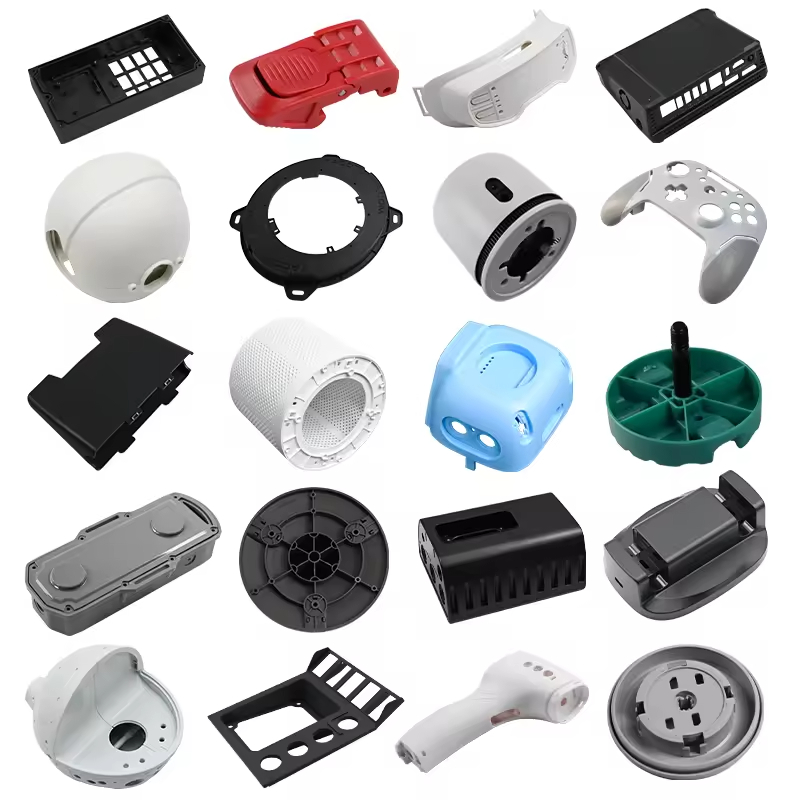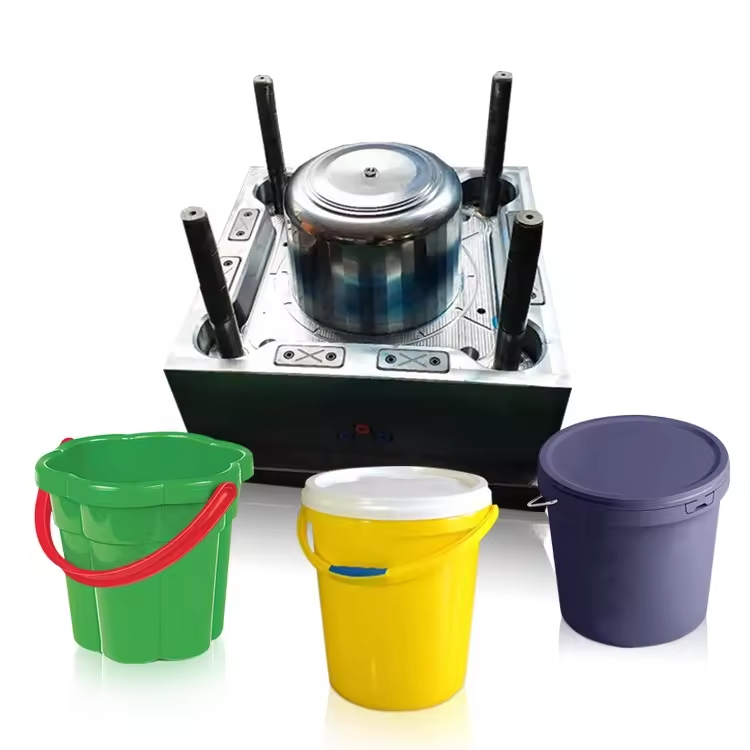
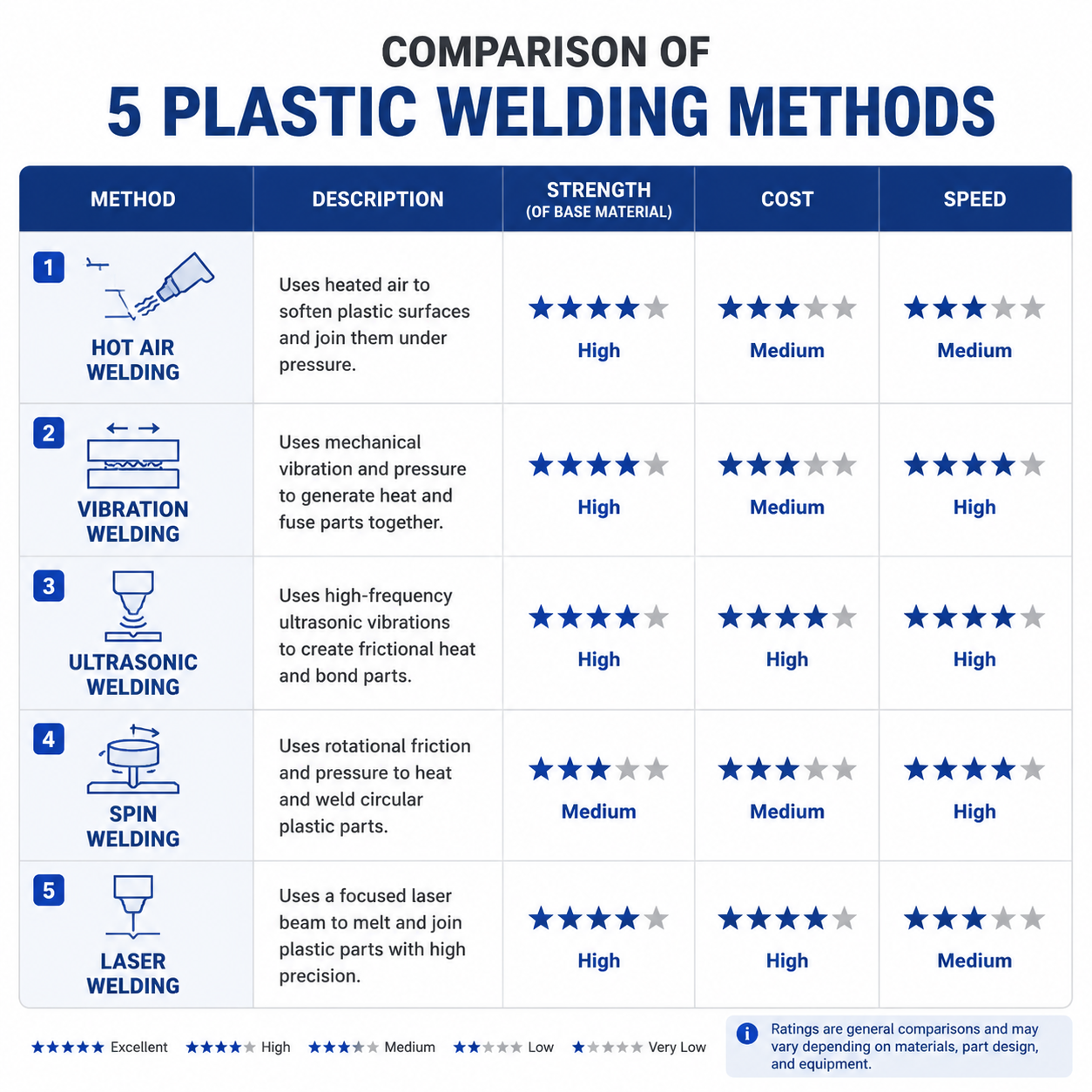
Injection molding produces individual parts, but many products require post-molding assembly to create a finished component. Plastic welding offers a permanent, clean joining method that avoids the cost and complexity of mechanical fasteners, while eliminating the chemical hazards and wait times of adhesives. Unlike snap-fits or screws, welding creates a monolithic bond with strength approaching the base material. This article compares five primary plastic welding methods used in production environments: ultrasonic, hot plate, vibration, laser, and spin welding. Understanding the trade-offs between these techniques is essential for selecting the right process for your part geometry, material, volume, and budget.
Ultrasonic Welding
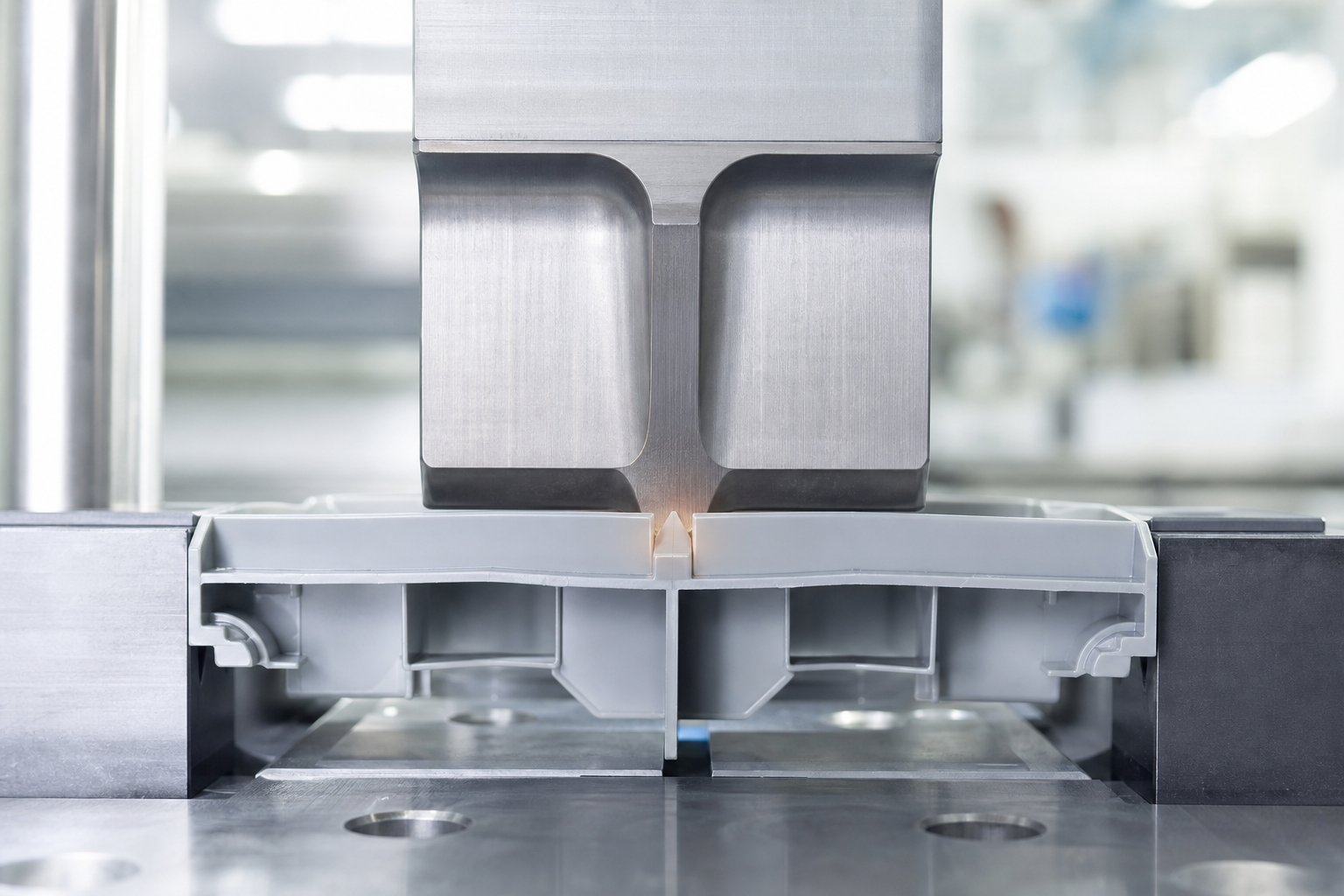
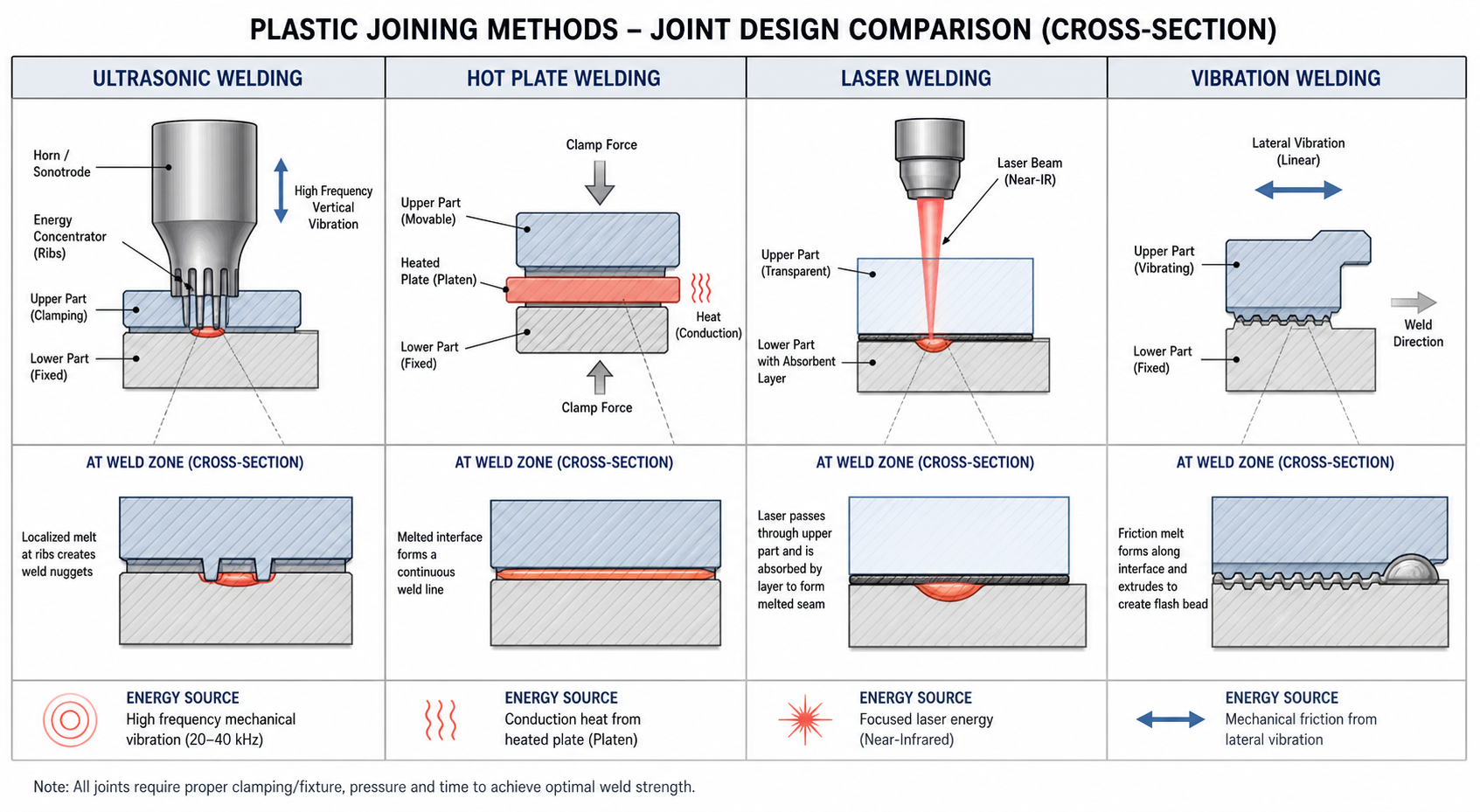
Ultrasonic welding uses high-frequency mechanical vibrations (20 kHz, 30 kHz, or 40 kHz) to generate frictional heat at the joint interface. A metal horn (sonotrode) presses against one part and transmits vibrations through the plastic, causing localized melting at the energy director. Typical cycle times range from 0.5 to 1.5 seconds, making it the fastest welding method available. Equipment costs range from ,000 to ,000 depending on power (500 W to 3000 W), frequency, and control features.
Rigid thermoplastics such as ABS, PC, PS, PMMA, PA (nylon), POM, and SAN weld well ultrasonically. Amorphous materials produce stronger bonds than semi-crystalline ones. Energy director design is critical: a V-shaped ridge (typically 60-90 degrees, 0.3-0.5 mm height) concentrates the vibrational energy at the joint interface. Joint configurations include shear joints for hermetic seals and butt joints for simpler geometries.
Hot Plate Welding
Hot plate welding brings both part surfaces into contact with a heated platen until they melt, then removes the platen and presses the parts together to fuse. Temperature accuracy is critical: typical hot plate temperatures range from 200-400 degrees C depending on the material. Cycle times are longer, typically 10 to 30 seconds per weld, including heating and cooling phases. Equipment costs range from ,000 to ,000 depending on size and control precision.
This method excels for large parts and assemblies where other methods cannot deliver uniform energy distribution. It works with nearly all thermoplastics, including glass-filled nylon (PA66 GF30), polypropylene, and polyethylene. The main disadvantages are the longer cycle time and the potential for material sticking to the hot plate surface. Non-stick coatings (PTFE) mitigate this issue.
Soldadura por vibración
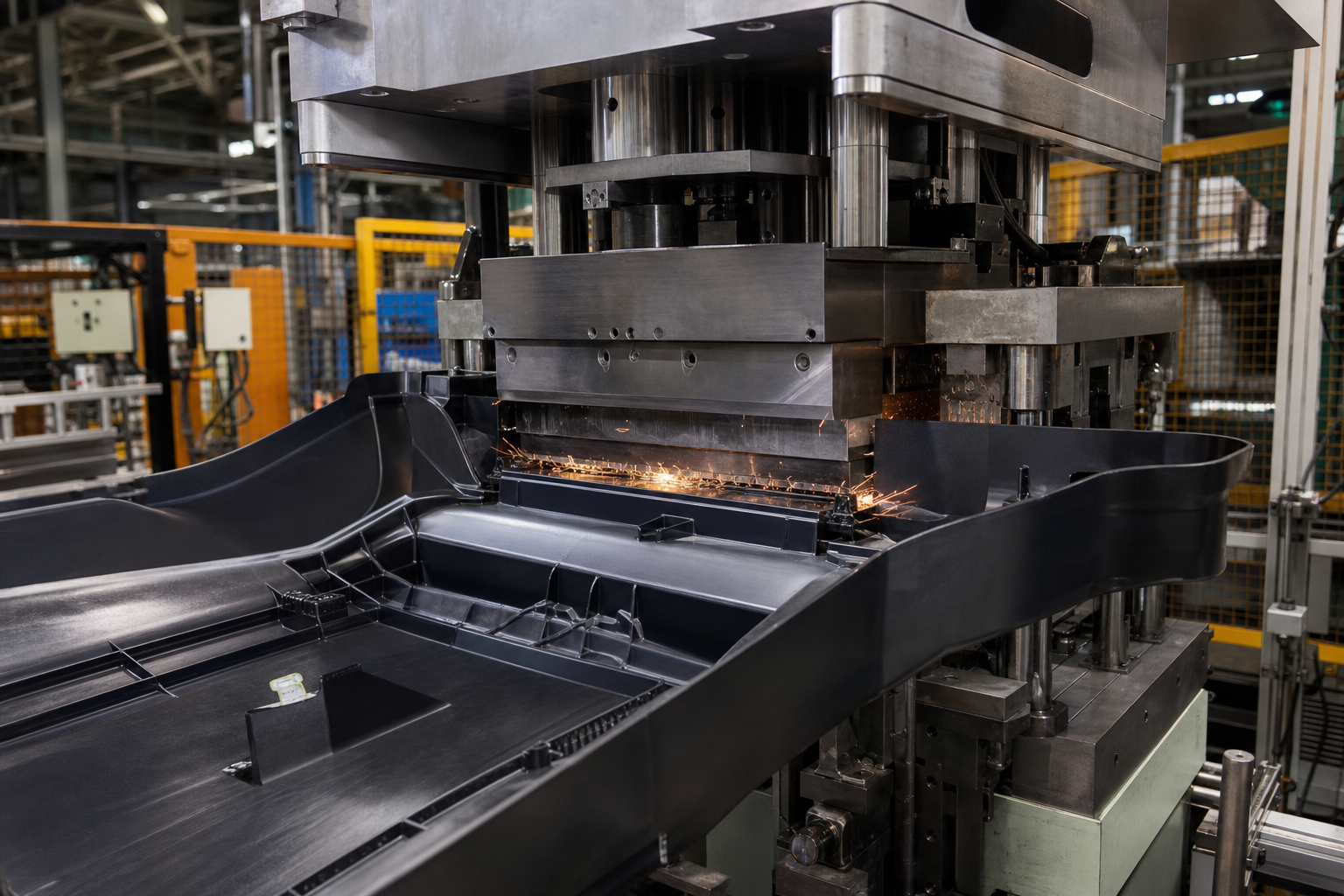
Vibration welding (also called friction welding) generates heat through linear or orbital motion of one part against the other at frequencies of 120-240 Hz, with amplitudes from 0.7 to 4.0 mm. Linear vibration welding reciprocates in one axis, while orbital welding creates a circular motion for better energy distribution on irregular shapes. Cycle times range from 2 to 10 seconds, and equipment costs range from ,000 to ,000.
The method is ideal for large, irregularly shaped parts that cannot be welded by ultrasound. Joint design requires a flat mating surface with a flash trap to contain the molten material. Vibration welding is compatible with most thermoplastics including PA66, PP, PE, POM, ABS, and PC. Semi-crystalline materials benefit from the sustained frictional heat, which melts the crystalline structure thoroughly. Hermetic seals are achievable with proper joint design.
Laser Welding
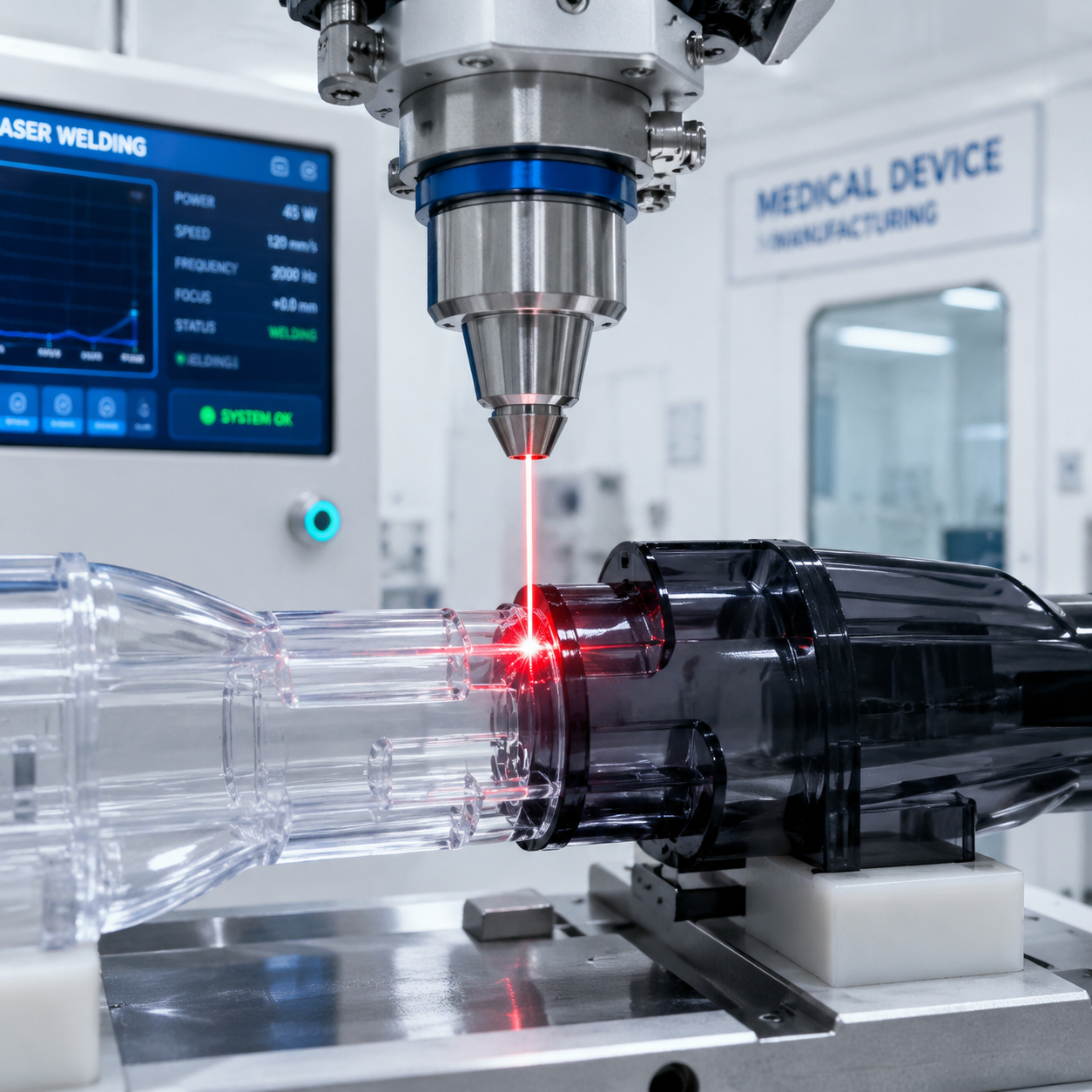
Laser welding uses the through-transmission principle: a laser beam passes through a laser-transparent top layer and is absorbed by a laser-absorbent bottom layer, melting the interface. Typical sources are diode lasers (800-1000 nm) or fiber lasers. The top part must be clear to the laser wavelength (natural or lightly colored), while the bottom part is typically dark, black, or contains an absorbing additive. Weld speeds can reach 10-20 m/min for continuous seams.
Laser welding delivers the highest precision of all methods, with weld widths as narrow as 0.1-0.5 mm. It generates no particulates, flash, or vibration, making it suitable for clean-room applications and sensitive electronics. Equipment costs are high, ranging from ,000 to ,000. It is best suited for small-to-medium parts where cosmetic appearance and precision matter, such as medical devices, sensors, and automotive electronics.
Spin Welding
Spin welding is the simplest welding method, suitable exclusively for circular or cylindrical parts. One component is rotated against a stationary part under controlled pressure until frictional heat melts the interface, then rotation stops and pressure is maintained during cooling. Equipment costs range from ,000 to ,000, and cycle times are 1 to 3 seconds. The technique works well for parts like filter housings, bottles, and round connectors. Material compatibility is broad, covering most thermoplastics including nylon, PP, PE, and POM.
Comparison of Plastic Welding Methods
| Parámetro | Ultrasónico | Placa calefactora | Vibración | Láser | Spin |
|---|---|---|---|---|---|
| Weld Strength | Bien | Excelente | Excelente | Excelente | Bien |
| Tiempo de ciclo | 0.5-1.5 s | 10-30 s | 2-10 s | 0.5-5 s | 1-3 s |
| Equipment Cost | - | - | - | - | - |
| Max Part Size | 200 mm | 1000+ mm | 1000+ mm | 300 mm | 200 mm diam. |
| Material Restrictions | Rigid only | Mínimo | Mínimo | Transparent top | Circular only |
| Visual Quality | Bien | Moderado | Moderado | Excelente | Bien |
| Seal Capability | Hermetic possible | Hermetic | Hermetic | Hermetic | Hermetic |
| Complejidad del diseño | Energy director | Flat mating surface | Flat + flash trap | Simple but tight | Simple circular |
| Automation Ready | Excelente | Bien | Bien | Excelente | Excelente |
| Energy Cost | Bajo | Medio | Bajo | Bajo | Bajo |
Material Weld Compatibility Matrix
Not all materials are compatible with all welding methods. The table below summarizes the feasibility of each welding method for common injection molding materials.
| Material | Ultrasónico | Placa calefactora | Vibración | Láser | Spin |
|---|---|---|---|---|---|
| PA66 (nailon 66) | Sí | Sí | Sí | Conditional | Sí |
| PA6 (nailon 6) | Sí | Sí | Sí | Conditional | Sí |
| POM (Acetal/Delrin) | Sí | Sí | Sí | Conditional | Sí |
| PC (policarbonato) | Sí | Sí | Sí | Conditional | Sí |
| PP (polipropileno) | Moderado | Sí | Sí | Conditional | Sí |
| ABS | Excelente | Sí | Sí | Conditional | Sí |
| PMMA (acrílico) | Bien | Sí | Sí | Conditional | Sí |
| PEEK | Moderado | Sí | Moderado | No | Sí |
Conditional for laser welding: the top layer must be laser-transparent (natural or lightly colored), and the bottom layer must contain an absorber (typically carbon black or near-IR absorbing additive).
Joint Design for Ultrasonic Welding
The energy director is the most critical design element for ultrasonic welding quality. Key parameters include:
- Angle: 60-90 degrees is standard. A 60-degree angle provides faster melting but requires tighter control. A 90-degree angle gives more consistent melt flow.
- Height: 0.3-0.5 mm for most applications. Taller energy directors (up to 0.8 mm) are used for larger parts or higher melt volume requirements.
- Junta de corte: Creates an interference fit between a small lip and a mating cavity. Provides excellent hermetic seals and is tolerant of part variation. Requires 0.1-0.3 mm interference per side.
- Butt joint: Simpler design with the energy director on one flat surface. Easier to mold but less tolerant of flash. Used for non-sealed applications.
Preguntas frecuentes
See our polypropylene vs nylon comparison for detailed grade selection and property data.
¿Qué método de soldadura es el más resistente para el nailon?
For nylon (PA6 and PA66), vibration welding and hot plate welding produce the strongest joints, typically achieving 90-100% of the base material strength. Nylon’s semi-crystalline structure benefits from the sustained heat input these methods provide, which fully melts the crystalline regions for complete fusion. Ultrasonic welding of nylon is possible but yields 60-80% of base strength, and requires careful tuning to avoid degradation from localized overheating, especially with glass-filled grades.
¿Se pueden unir dos piezas de plástico negro mediante soldadura láser?
La soldadura láser convencional por transmisión no puede unir dos piezas negras, ya que ambas capas absorberían la energía del láser en la superficie en lugar de transmitirla a la interfaz. Sin embargo, existen métodos especializados: la tecnología «clear-weld» utiliza aditivos que absorben el infrarrojo cercano y son invisibles a simple vista, lo que permite que ambas piezas parezcan negras, mientras que una de ellas sigue siendo transparente a la longitud de onda del láser. Como alternativa, se puede utilizar una capa intermedia transparente entre dos piezas negras. Estos métodos aumentan el coste de los materiales y la complejidad del proceso.
¿Cuál es el método de soldadura más económico para la producción en serie?
Para la producción a gran escala, la soldadura por ultrasonidos ofrece el menor coste por pieza gracias a sus tiempos de ciclo inferiores a un segundo y a una inversión moderada en equipamiento (-). La soldadura por rotación también es económica (- equipamiento), pero se limita a piezas circulares, lo que restringe su aplicabilidad. Cuando se tiene en cuenta el coste total de propiedad, incluyendo la energía, el mantenimiento y la mano de obra, la soldadura por ultrasonidos suele ser la opción más ventajosa para piezas de menos de 200 mm. En el caso de piezas muy grandes, la soldadura por vibración resulta más rentable a pesar del mayor coste del equipo, ya que permite trabajar con geometrías más grandes sin necesidad de múltiples estaciones.
¿Se puede utilizar la soldadura por ultrasonidos con nailon reforzado con fibra de vidrio?
Sí, pero con algunas salvedades importantes. El nailon reforzado con fibra de vidrio (PA66 GF30 o PA6 GF30) puede soldarse por ultrasonidos, pero las fibras de vidrio reducen el índice de soldabilidad. El contenido de fibra de vidrio aumenta la viscosidad de la masa fundida e inhibe la difusión molecular a través de la interfaz de soldadura. Entre los ajustes recomendados se incluyen el uso de frecuencias más bajas (20 kHz en lugar de 40 kHz) para lograr una mayor penetración de la energía, aumentar la altura del director de energía a 0,5-0,8 mm y añadir entre 20 y 30% más tiempo de soldadura o amplitud. La resistencia de la soldadura suele alcanzar entre el 50 y el 70 % de la resistencia del material base, en comparación con el 80 % de los grados sin relleno. La soldadura por placa caliente o por vibración son alternativas preferibles para el nailon relleno de fibra de vidrio cuando se requiere la máxima resistencia.