Two-Shot Es un tema práctico de ingeniería cuando hay que comparar opciones, comprobar los límites y elegir un proceso que presente menos riesgos.
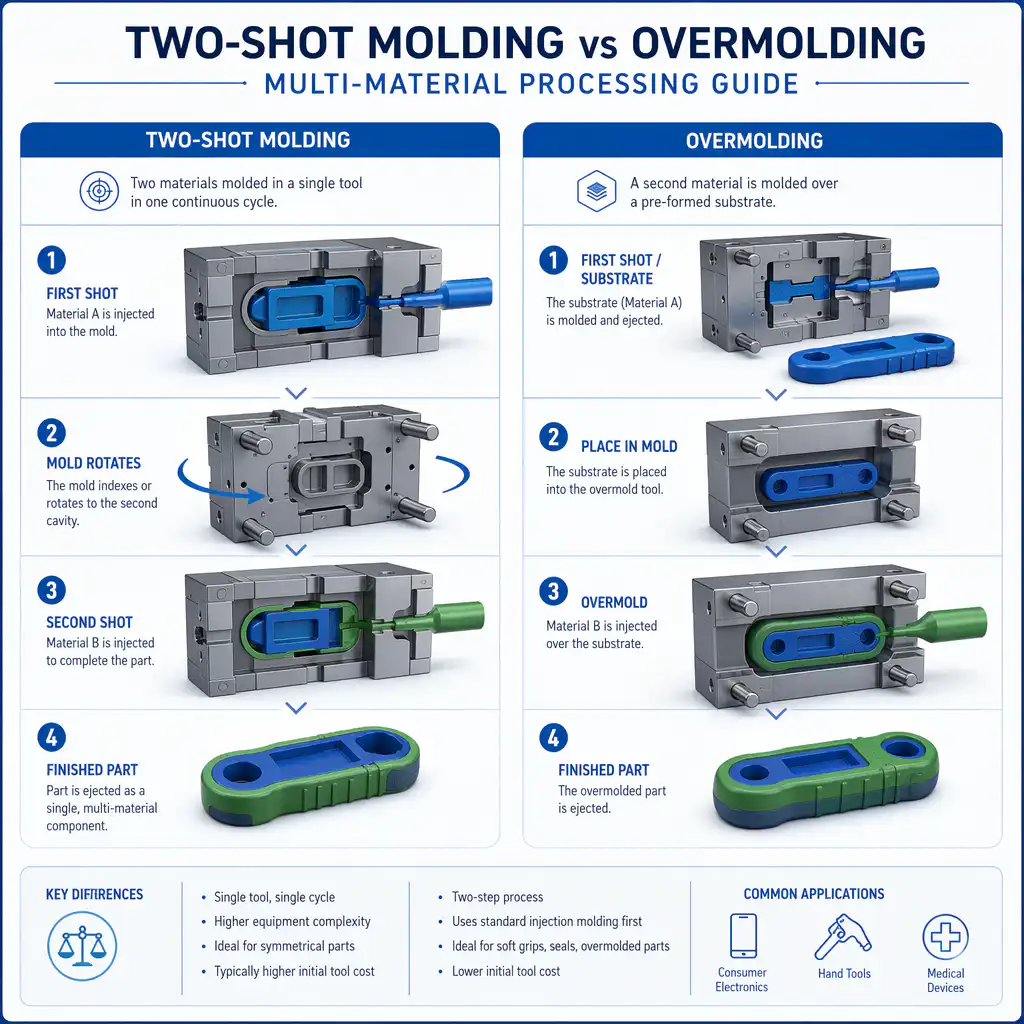
Multi-Material Molding Overview

Multi-material molding combines different materials in a single part to achieve functional or aesthetic benefits. Two-shot molding and overmolding are the primary techniques, each with distinct advantages.
Two-Shot Molding
Two-shot molding (also called 2K molding or multi-component molding) injects two different materials in a single molding cycle using a specialized machine with two injection units.
Descripción del proceso
- First material injected into mold cavity
- Mold rotates or transfers to second position
- Second material injected over or alongside first
- Part ejected as complete unit
Ventajas
- Excellent material bonding (chemical bond possible)
- High precision and repeatability
- Single cycle production
- Design flexibility for complex geometries
- Reduced labor and handling
Disadvantages
- Higher machine and tooling cost
- Requires specialized equipment
- Less flexibility for design changes
- Longer tooling lead time
Sobremoldeo
Overmolding uses two separate molding cycles. A substrate part is molded first, then placed in a second mold where additional material is injected over it.
Descripción del proceso
- Substrate molded in first mold
- Substrate placed in second mold
- Second material injected over substrate
- Completed part ejected
Ventajas
- Lower equipment cost
- Can use standard injection machines
- More design flexibility
- Easier to change colors/materials
- Suitable for lower volumes
Disadvantages
- Requires two molding cycles
- Additional handling and labor
- Bond quality depends on mechanical interlock
- Higher per-part cost at high volumes
Compatibilidad de materiales
Aplicaciones
Two-Shot Molding:
- Automotive interior components
- Medical devices with soft grips
- Consumer electronics buttons and keys
- Sealed enclosures with gaskets
Sobremoldeo:
- Tool handles and grips
- Encapsulated electronics
- Cable connectors
- Product branding and logos
Decision Factors
- Volume: High volume favors two-shot; low volume favors overmolding
- Bond requirements: Chemical bond needs two-shot
- Budget: Overmolding has lower upfront costs
- Equipamiento: Two-shot requires specialized machines
Conclusión
Both techniques produce multi-material parts successfully. Evaluate production volume, bond requirements, and available equipment to determine the best approach.
Recursos relacionados
- Guía de temperaturas de impresión en nailon
- Mecanizado CNC Nylon
- Impresión 3D para prototipos frente a producción
- Guía de selección de materiales plásticos
- Factores de coste de los plásticos técnicos
Process Decision Table for Production Parts
| Decision factor | Two-shot molding | Sobremoldeo |
|---|---|---|
| Tooling route | One indexed or rotary tool with two injection units | Separate substrate and overmold steps, or an insert tool |
| El más adecuado | High registration, repeatability and production volume | Flexible launches, inserts or lower initial tool complexity |
| Main risk | Transfer alignment, shot balance and interface validation | Insert position, surface preparation and bond variation |
| Validation | Registration, weld lines and interface strength | Retention features, cleanliness and pull testing |
Choose after checking the material pair, annual volume, gate and parting-line limits, substrate tolerance and the test method for the completed interface. Include the DFM drawing, material datasheets, trial plan and bond requirement in the RFQ. See the overmolding guide for the broader tooling route.
PREGUNTAS FRECUENTES
When does Two-Shot Molding vs Overmolding — Multi-Material Processing Guide make sense?
Two-Shot Molding vs Overmolding — Multi-Material Processing Guide makes sense when the part volume, material choice, geometry, and repeatability needs justify mold design and tooling investment.
What design factors matter most for Two-Shot Molding vs Overmolding — Multi-Material Processing Guide?
El espesor de las paredes, las nervaduras, las salientes, el ángulo de desmoldeo, la ubicación de la entrada de material, la contracción, la línea de separación y la expulsión influyen en la calidad de la pieza moldeada.
¿Qué información se necesita antes de la fabricación del molde?
El proveedor deberá confirmar el modelo 3D, el material, el volumen anual previsto, los requisitos de aspecto, las tolerancias requeridas y cualquier requisito relativo al montaje o a las pruebas funcionales.
What is the biggest risk in Two-Shot Molding vs Overmolding — Multi-Material Processing Guide?
El mayor riesgo es aprobar el utillaje antes de haber comprobado exhaustivamente el comportamiento del material, la contracción, el flujo y el funcionamiento de la pieza en relación con la aplicación real.