A well-designed snap fit is engineering elegance—a single polymer feature that replaces screws, clips, adhesive, and assembly labor in one molding cycle. The challenge: snap fit design lives at the intersection of material science, mold flow analysis, and structural mechanics. Get the beam length, deflection angle, or material selection wrong by 10%, and your tool-less assembly becomes a field failure.
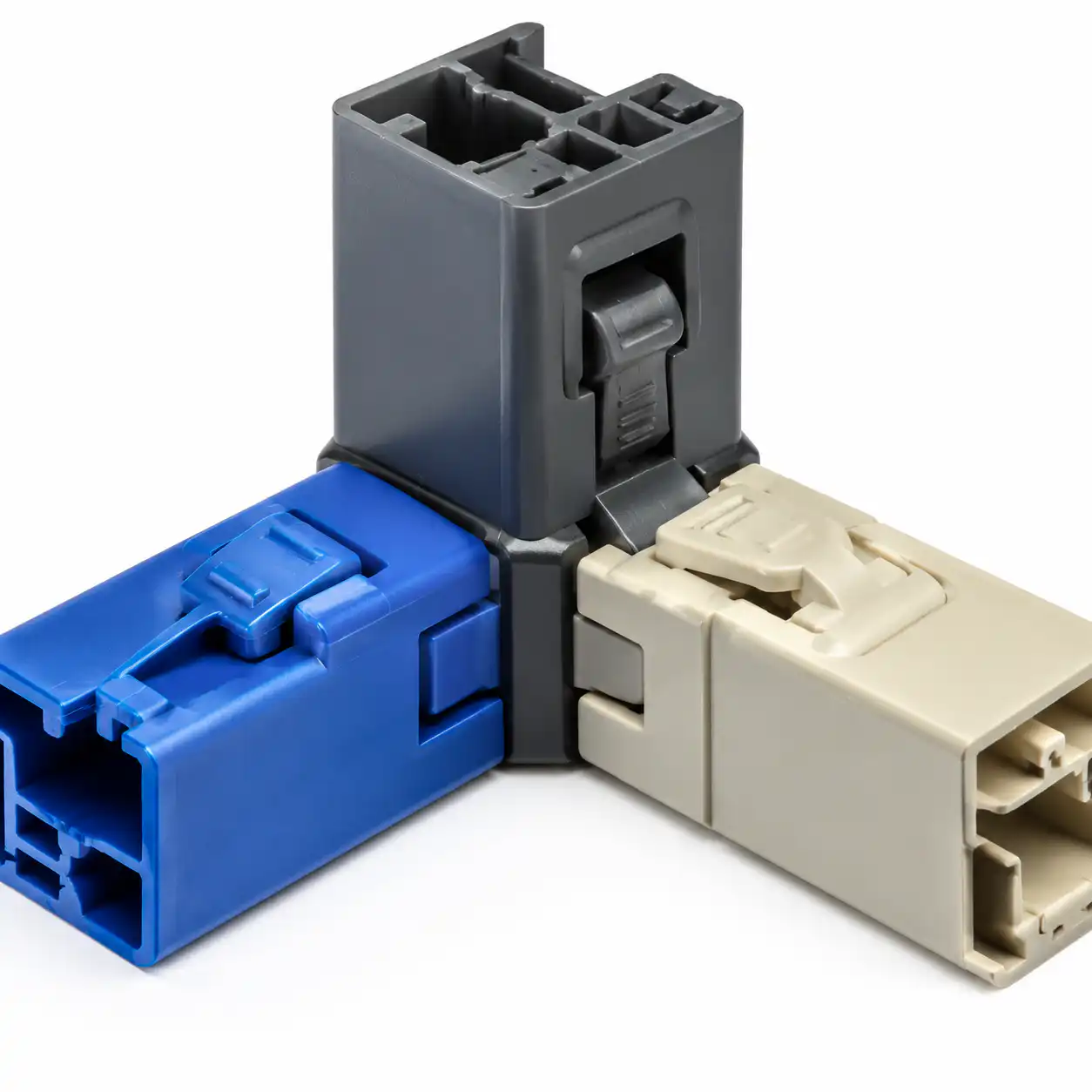
This guide covers the three fundamental snap fit types, material-dependent design equations, and the practical mold design considerations that separate prototypes from production-ready parts.
Para los equipos de ingeniería y de aprovisionamiento
Reviewing a Snap Fit Before Mold Release?
A snap fit should be checked as a material, geometry, assembly and tooling system. Beam strain, root radius, draft, undercut direction and repeated-use requirements can all change the final design.
- Define one-time assembly or repeated service before sizing the feature
- Check allowable strain in the conditioned production material
- Confirm parting line, shutoff, ejection and side-action requirements
Request a snap fit DFM review → Review core and cavity design guidance
The Three Fundamental Snap Fit Types
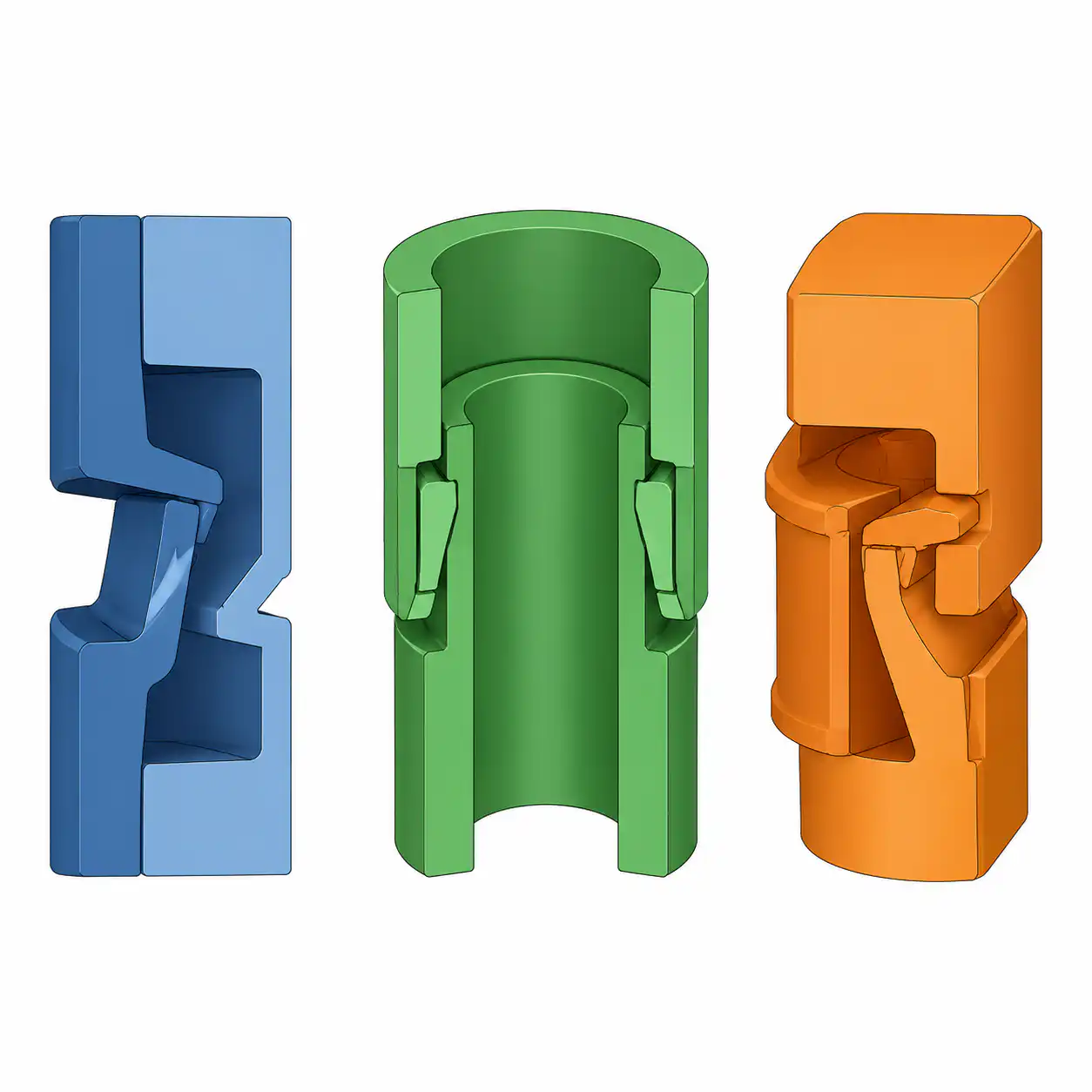
Every snap fit design derives from one of three basic geometries, each with its own stress distribution and application sweet spot:
| Tipo | Deflection Mode | Stress Concentration | Lo mejor para |
|---|---|---|---|
| Cantilever Beam | Bending | At root (max bending moment) | Enclosure covers, battery doors—80%+ of all snap fits |
| Annular (Cylindrical) | Hoop expansion | Distributed around circumference | Pen caps, tube connectors, ball-and-socket joints |
| Torsional | Torsion | At torsion bar ends | Hinges, latches, living hinges requiring repeated flex cycles |
Material-Dependent Design Limits
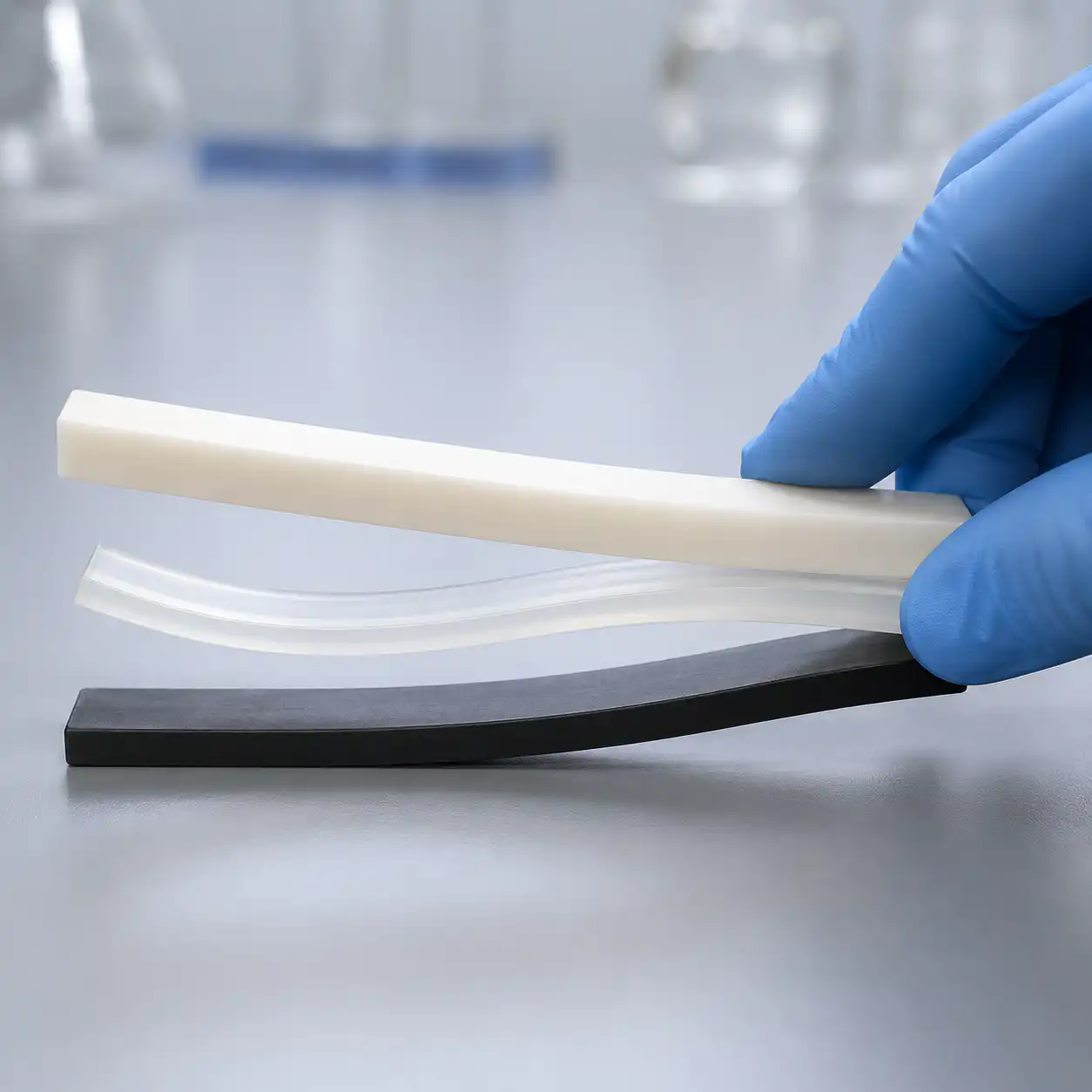
The governing equation for a cantilever snap fit derives from classical beam theory. For a rectangular cross-section beam: yₘₐₓ = (2/3) × (ε_yield × L²) / (h × Q), where Q is the deflection magnification factor (1.5-2.0 for tapered beams). The critical constraint is the material’s yield strain—and this varies dramatically between materials.
| Material | ε_yield | Max y/L Ratio | Snap Fit Grade |
|---|---|---|---|
| Policarbonato (PC) | 4-5% | 0.10-0.12 | ⭐⭐⭐⭐ Excellent |
| Nylon 6 (PA6, conditioned) | 5-8% | 0.12-0.15 | ⭐⭐⭐⭐⭐ Best in class |
| ABS | 2.5-3.5% | 0.05-0.07 | ⭐⭐⭐ Good, common in consumer |
| PA66 GF30 | 1.5-2.0% | 0.03-0.04 | ⚠ Short beams only (<5× thickness) |
| POM (Acetal) | 3-4% | 0.06-0.08 | ⭐⭐⭐ Good, but susceptible to creep |
⚠ Critical warning: Glass-filled materials have yield strains 2-4× lower than unfilled grades. A snap fit dimensioned for unfilled PA6 will fracture immediately if molded in PA6 GF30. Always verify material-specific strain limits before committing to tooling.
Design Rules for Injection Molded Snap Fits
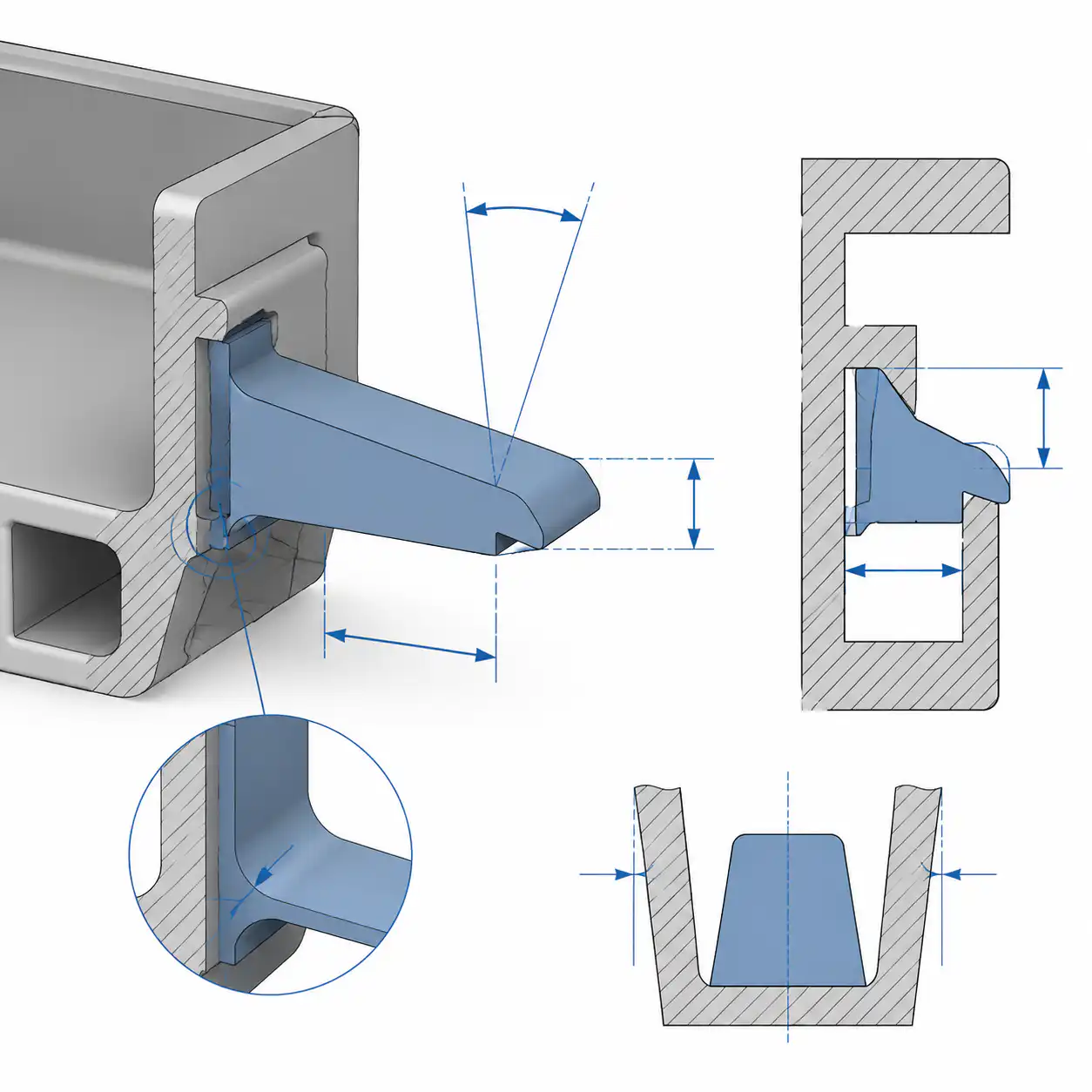
- Beam aspect ratio: Length-to-thickness ratio 5:1 to 10:1. Below 5:1, deflection too stiff; above 10:1, buckling risk and unreliable mold filling.
- Taper: Reduce beam thickness linearly from root to tip by 25-50%. Tapering distributes bending strain evenly, increasing allowable deflection by 40-60%.
- Root radius: Minimum 0.5 mm radius at beam root. Sharp corners create stress concentrations exceeding 3× nominal bending stress—guaranteed fracture initiation.
- Undercut depth: Keep retention undercut to 0.5-1.5 mm. Deeper undercuts need longer beams and increase mold complexity (lifter/slide required).
- Gate location: Never gate directly at the snap fit root. A root-gated snap loses 30-50% strength from the weld line. Gate on the opposite side of the part.
- Mold split line: Position snap fit entirely in one mold half. A parting line through a snap beam creates flash that acts as a crack initiator.
Matriz de aplicaciones industriales
| Industria | Piezas típicas | Snap Type | Material preferido |
|---|---|---|---|
| Electrónica de consumo | Phone cases, remote housings, laptop bezels | Cantilever (multiple) | PC/ABS—stiffness + toughness + finish |
| Automoción | Interior trim panels, HVAC vents, fuse covers | Cantilever + Annular | PP-TD20—low cost, good snap performance at interior temps |
| Médico | Disposable device housings, vial holders | Cantilever | PP homopolymer—sterilizable, >1M hinge cycles |
| Industrial | Machine guards, electrical enclosures | Cantilever (heavy) | PA6 conditioned—toughness + 80°C continuous service |
Marco de decisión sobre costes
Snap fits incur zero incremental part cost and zero assembly labor cost—the most cost-effective fastening method in injection molding. A single cantilever snap replaces approximately $0.03-0.08 in screw + insert + assembly cost per joint.
For a product with 6 snap fits replacing 6 screws and brass inserts, per-unit savings is roughly $0.30-0.50. At 100,000 units/year, that’s $30,000-50,000 in annual savings.
A cambio: Snap fits increase mold complexity. A mold with 4 undercut features requires lifters/slides adding $2,000-5,000 each. The ROI is compelling: mold cost recovered within 10,000-20,000 parts through assembly savings.
Defectos habituales y soluciones
| Defecto | Apariencia | Causa principal | Solución |
|---|---|---|---|
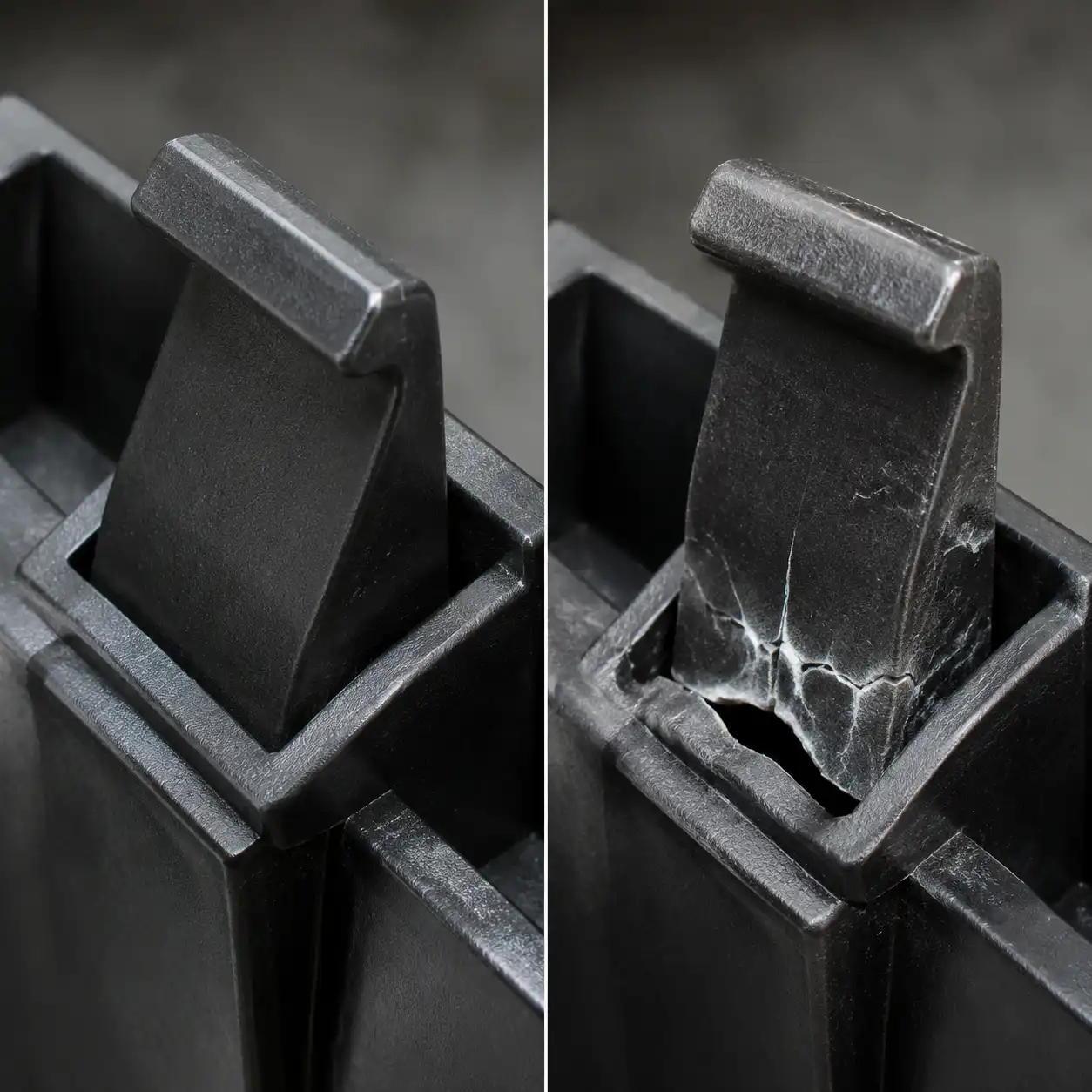
| Fracture on first engagement | Snap beam breaks before full engagement | Deflection exceeds material yield strain | Increase beam length 20-30%; taper profile; switch to higher-strain material |
| Creep relaxation | Snap loses retention force over weeks/months | Constant stress exceeds creep limit at service temp | Reduce engagement strain to <50% yield; use glass-filled; add secondary lock |
| Fatigue failure | Snap breaks after repeated use (50-500 cycles) | Strain amplitude too high for fatigue life target | Keep strain ≤20% yield for >10K cycles; generous root radius |
| Mold sticking | Snap beam tears or scuffs during ejection | Insufficient draft or undercut on sidewalls | Add 0.5-1° draft on all vertical surfaces; polish to SPI A2 or better |
¿Por qué elegir el plástico de nailon para tu proyecto?
Fabricación de precisión
30+ CNC & injection molding cells under one roof
ISO 9001:2015
Sistema de calidad certificado, informes de inspección completos
Plazo de entrega de 15 a 25 días
Plazos de entrega rápidos, con opciones de envío urgente disponibles
Envíos internacionales
Air & sea freight to North America, Europe, Asia
Download Our Snap Fit Design Guide
Guía de referencia gratuita en formato PDF que incluye tablas de selección de materiales, normas de diseño y listas de verificación para la evaluación de proveedores.
Artículos relacionados
¿Qué tipo de plástico de nailon se puede personalizar para este proyecto?
Nylon Plastic combina la modificación de materiales con el diseño de productos, el diseño y la fabricación de moldes, el moldeo por inyección, el mecanizado CNC y la impresión 3D. El ámbito de aplicación adecuado se selecciona a partir del plano y las condiciones de uso, y no se determina en función de la denominación genérica del material.
| Área de personalización | Opciones que hay que revisar | Información necesaria |
|---|---|---|
| Elección de materiales | Unfilled or reinforced nylon and alternative polymer review | Assembly cycles, strain, temperature, moisture and chemical exposure |
| Joint geometry | Cantilever, annular or torsional concept and tolerance review | CAD, mating part, insertion force and retention target |
| Tooling strategy | Parting line, shutoff, draft, ejection and side-action DFM | Undercut direction, cosmetic zones and mold constraints |
| Validation route | 3D print, CNC, prototype tool or production mold planning | What must be tested and how closely it must represent production material |
Lista de comprobación para solicitudes de presupuesto
- CAD for both mating components and the assembly direction
- One-time or repeated-use requirement and target cycle count
- Insertion, retention and allowable removal force
- Material, conditioning state and operating environment
- Annual volume, appearance class and validation method
Durante la elaboración del presupuesto se pueden tratar cuestiones como el apoyo en materia de DFM, los acuerdos de confidencialidad (NDA), la documentación sobre materiales o composiciones y los requisitos de inspección. La disponibilidad depende del alcance del proyecto y del plan de calidad acordado.
De la revisión a la producción
- Definición: compartir el plano, la aplicación, el entorno y el volumen.
- Reseña: comparar los riesgos relacionados con los materiales, los procesos, el diseño para la fabricación (DFM) y la validación.
- Validar: utilizar muestras, impresión 3D, CNC o utillaje de prototipos cuando sea pertinente.
- Productos: no dar el visto bueno a las herramientas o a la producción hasta que se hayan completado las comprobaciones acordadas.
De un vistazo
| Punto de decisión | What Matters Most | Nota para el comprador |
|---|---|---|
| Deflection | Material strain limit | Keep the snap below its safe flex range |
| Root stress | Radius and thickness | Control the root first to avoid early failure |
| Assembly force | Lead-in angle and draft | Reduce insertion effort without weakening retention |
| Uso recomendado | Repeatable enclosure and housing assembly | Design for assembly, not just retention |
Lecturas relacionadas
- Injection Molding Guide
- Guía sobre el sobremoldeado de piezas de plástico
- Servicios de moldeo por inyección de nailon
Preguntas frecuentes
Can Nylon Plastic recommend a material for a snap fit?
The review can compare unfilled PA, PA-GF20, PA-CF30 and other engineering plastics against allowable strain, fatigue, moisture, temperature and assembly use. The final recommendation needs the actual beam geometry and cycle requirement.
Can a snap-fit undercut be molded without a side action?
Sometimes a flexible part can strip from the tool, but the decision depends on undercut depth, material strain, draft, surface and ejection direction. Tooling review is required before assuming a simple mold.
How should a repeated-use snap fit be validated?
Define the assembly cycle count, insertion and retention force limits, temperature and conditioning state. Test representative production-material parts after aging or environmental exposure when those conditions matter.
What should be sent for a snap-fit DFM quote?
Send both mating CAD models, drawings, assembly direction, force targets, material preference, cycle requirement, annual volume and any cosmetic or tooling restrictions.
What is the most common snap-fit design mistake?
The most common mistake is checking only initial retention while ignoring root strain, moisture-conditioned dimensions, assembly speed and repeated cycles. Review the root radius and material condition before finalizing the mold.
Request a Custom Snap-Fit Review
Send the drawing, mating part, operating conditions, assembly cycle target, material preference and expected quantity for a DFM review.